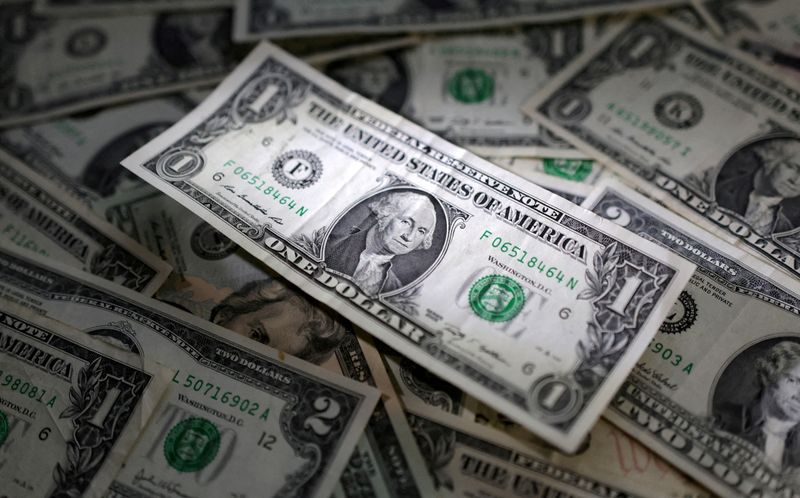
Slowdown in money-fund cash flow hits short-term Treasuries

By Gertrude Chavez-Dreyfuss
NEW YORK, Oct 6 (Reuters) - A stream of investor cash flowing into money-market funds has slowed significantly this year, pushing up yields on Treasury bills and potentially
leaving markets vulnerable to short-term funding issues.
Money fund inflows have totaled just $158 billion in the first three quarters this year, TD Securities data show, down from $823 billion for the full year of 2025 and $840 billion in 2024.
Reduced money-fund inflows have hit demand for T-bills, analysts said, lifting their yields in recent sessions relative to comparable overnight index swaps (OIS), a key money market benchmark that reflects Federal Reserve rate-increase expectations embedded in swap markets.
"If money funds are not getting those inflows, then they have to think about where they want to put their money," said Sam Earl, US rates strategist at Barclays.
Money market funds, however, remain net buyers of Treasury bills, though demand has slowed markedly. By the end of August, those holdings had increased roughly 4% from year-end 2025, according to the latest Investment Company Institute data, versus an 18% rise over all of 2025.
SIGNS OF INVESTOR CONCERN
That softer pace of demand is beginning to show up in the relative pricing of Treasury bills, with investors requiring a larger premium to hold them.
US 3-month bill yields rose nearly 10 basis points above 3-month OIS on Monday, after hitting last week the widest spread since September 2024. For six-month maturities, that spread was at 11.3 basis points on Monday, touching 12.5 last week, the highest since April 2025.
The spread measures the bill's valuation relative to the market's implied path for short-term Fed policy. If T-bills are yielding more, it suggests investors are demanding extra compensation to hold US short-term debt, typically valued for liquidity and near risk-free status.
Nafis Smith, principal and head of taxable money markets at Vanguard, said the strength of the US equity market this year has helped crimp money fund flows by reducing the investor impulse to put money into cash. The S&P 500 is up 13% this year and the Nasdaq is up 18%.
Alongside the slowdown in money-fund buying, the rise in bill yields reflects expectations of heavy Treasury supply in the fourth quarter and more interest rate hikes from the Federal Reserve, analysts said.
Barclays estimates that the Treasury will issue roughly $225 billion of bills in October and another $160 billion in November. That should push yields higher as the Treasury floods the market with short-term securities. Yields have been rising at the long end of the curve as well, reflecting heavy corporate debt issuance to fund the AI buildout, deficit spending in the US and around the world and strong domestic economic growth.
"The Treasury is keen to focus more of the issuance on the very front of the curve in bills, but the largest source of demand is slowing and that's concerning," said Gennadiy Goldberg, head of US rates strategy at TD Securities.
Higher yields, if they persist, could alter cash flows across short-term funding markets. If money funds move cash out of overnight repo markets and into higher-yielding Treasury bills while bill issuance ramps up, funding conditions could tighten, pushing up repo rates and raising financing costs for dealers and market participants.
It’s too early to sound the alarm on that front though, analysts said. Money fund inflows typically accelerate in the fourth quarter as investors build cash ahead of year-end liquidity needs, tax payments, and portfolio rebalancing.
RATE UNCERTAINTY PREVAILS
For now, higher bill yields further reflect growing uncertainty over where interest rates are headed. US rate futures have priced in one rate hike of 25 basis points this year, and two more in 2027, LSEG estimates showed.
Money fund managers tend to shorten portfolio maturities when they anticipate higher interest rates. Shorter-dated debt matures more quickly, allowing managers to reinvest at higher yields if the Fed raises rates.
"We have this ebb and flow around rate hike expectations and for a money fund that's focused on capital preservation, that uncertainty creates a natural incentive to remain short," said Vanguard's Smith.
Money funds' weighted average maturity (WAM) — the average time until securities held by a fund mature — has declined to 36 days last month from a peak of 42 days in May, TD data showed. That’s still well above the 2022 low of just 15 days.
For now, the move in Treasury bill rates does not appear to be a sign of stress in underlying funding.
Repo markets, often the first place where funding strains emerge, have remained orderly, analysts said. Treasury officials have also repeatedly highlighted continued strong demand for bills from stablecoins and money funds even if it has softened slightly, but for now caution seems to prevail.
"We're seeing volatility on the short end that I don't think the market has been accustomed to," said Vanguard's Smith. "That creates an incentive for a money fund to be shorter and try to demand a higher risk premium."
(Reporting by Gertrude Chavez-Dreyfuss, editing by Colin Barr and Nick Zieminski)