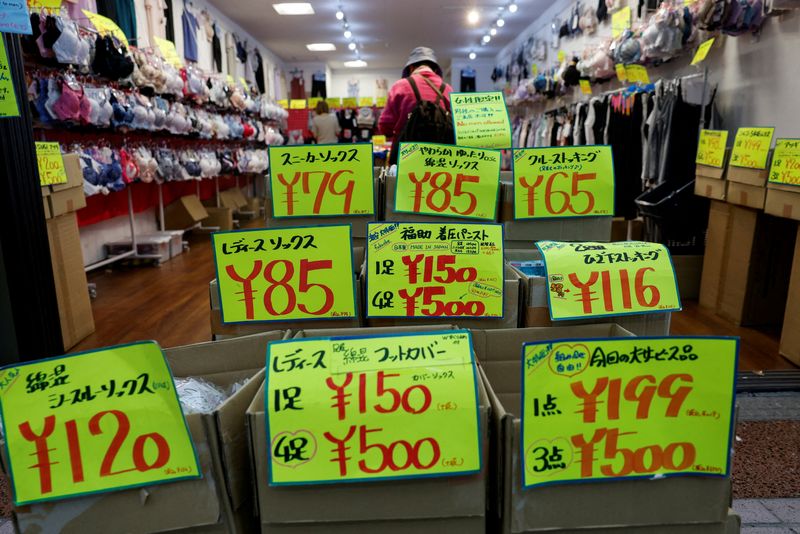
Analysis-Japan Inc seeks new hedges for a long era of yen weakness

By Anton Bridge and Miho Uranaka
TOKYO, Aug 25 (Reuters) - Taku Ueno buys beef from America, olive oil from Spain and tomatoes from Italy to stock his supermarkets south of Tokyo, imports that have more
recently become costlier almost by the day as the yen falls relentlessly.
The yen has weakened despite currency intervention in 2022, 2024 and 2026, and the exchange rate is still under pressure, even after rare joint U.S.-Japan buying in August and July.
Ueno, chief executive of Takara MC, which operates 43 supermarkets, and his counterparts across Japan are losing patience and looking for ways to insure against further weakness.
He has pushed for direct and longer-term contracts with his overseas suppliers, which lock in prices and exchange rates at up to a year at a time, and help him avoid raising prices too quickly, which risks losing his customers.
Others, bankers say, are turning to futures, forwards and options, to hedge against further yen weakness as authorities struggle to come up with fresh ways to steady or turn the currency.
While smaller firms have historically avoided using such instruments, choosing instead to absorb modest import price hikes, cost pressures are now too great not to take action.
"For U.S. beef, we used to negotiate every month, but the exchange rate is changing so quickly we now negotiate every three months," said Ueno.
"This means we don't have to raise prices for three months at least," he said.
Not that it's easy to strike deals in a market where the yen is far and away the worst-performing G10 currency, having lost more than 30% on the dollar over the past five years.
"Japan is completely losing its buying power," said Ueno, who finds himself routinely outbid on beef deals lately by buyers from China or Thailand. "You have to go to suppliers in person and bow your head to make a purchase."
LOCKED IN FOR 10 YEARS
Driving the yen's long decline are Japan's relatively low interest rates and the central bank's slow pace of hikes. Under Prime Minister Sanae Takaichi, investors have also grown concerned about Japan's debt load.
The yen hit a near 40-year low in July, just shy of 164 per dollar, before authorities intervened. It last traded around 159 to the dollar.
To be sure, the falling yen is still a boon for exporters and firms with foreign earnings, keeping them competitive and flattering their financial results when reported in yen terms.
But even they now seek stability as importers struggle to bear additional currency losses.
Nitori Holdings, Japan's largest furniture chain, buys many of its products from abroad and estimates each rise in the dollar-yen exchange rate of 1 yen hits its profit by around 2 billion yen ($12.5 million).
It doesn't hedge its exposure at present but would consider currency forwards if extreme yen weakness continues long-term, a company spokesperson said.
Daiwa Securities said it has seen hedging demand boom and Bank of America said it boosted headcount in its Japan FX team over the past two years to meet higher hedging demand.
Firms are now protecting themselves from further declines rather than assume the exchange rate will return to previous levels, said Akira Hirayama, executive director in the product marketing department at Daiwa Securities.
"Previously companies would hedge through banks just for a few months to a year. Now there are cases where customers want to lock rates in for as long as five to 10 years," Hirayama said.
SHORT-TERM SHIFTS
Options markets also reflect long-term pessimism on the yen.
Since the joint intervention, as well as a hawkish shift in market pricing for Japan's interest rate outlook, short-term options pricing has shown a jump in the cost of insuring against a rise in the yen.
But at the one-year tenor the market hasn't really budged, and nor, bankers say, have most investors' views.
"I think while some Japan-based market participants argue that the tide in the FX market has turned, most investors including offshore accounts, remain sceptical," said Daiki Hayashi, head of Japan sales and marketing at J.P. Morgan.
"The prevailing view is that no-one intends to push dollar-yen materially below 150. So the dominant thinking in the market is that the 155 and 165 range is likely to persist."
Even so, exporters are now considering hedging against a stronger yen to lock in overseas profits, said Namato Nagahama, head of global foreign exchange sales at Bank of America in Tokyo.
"Everyone is wondering whether the dollar-yen has peaked here, but no one knows what will happen next because companies have kept seeing the yen weaken even while people kept calling each level a 'key level,'" Nagahama said.
($1 = 159.3400 yen)
(Reporting by Anton Bridge and Miho Uranaka in Tokyo and Tom Westbrook in Singapore; Editing by Sam Holmes)