Reaction to US curbs on AI chips that threaten data centre boom

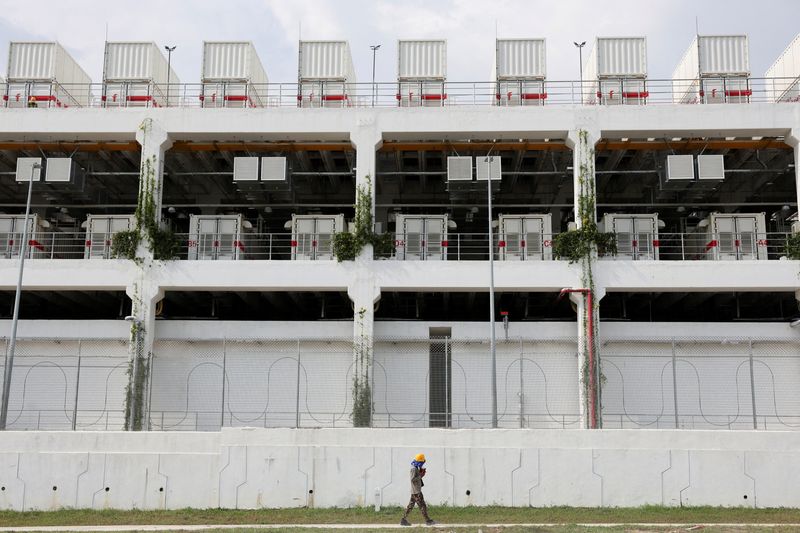
Nov 17 (Reuters) - Shares of data centre and chip supply chain companies in Southeast Asia tumbled on Tuesday after the US said it would restrict shipments of advanced chips from companies such as Nvidia
to the region.
Some Chinese firms used the facilities to access computing power to train AI models. The US rule identifies Singapore, Thailand, Malaysia, Indonesia and Brazil as countries where advanced chips are at higher risk of being diverted to China.
SUPPARAT SIVAPETCHRANAT SINGHARA NA AYUTTHAYA, VICE CHAIRMAN, THAI DATA CENTER ASSOCIATION, WITH MORE THAN 100 MEMBERS:
"Obviously, it has a direct impact. There is ... about maybe 300 MW equivalent of GPUs we expect to be coming into the country over the next 12 to 18 months. Those 300 GPUs obviously were targeted towards Chinese end users.
"Capex for these 300 equivalent GPUs are roughly about $12 billion to $18 billion.
"However, because of the recent mid-term elections in the US, there is a slowdown of data center approvals in Texas and Ohio. Naturally the US customers are looking for additional capacity.
"So though the situation has triggered ... a halt of Chinese end users to utilise GPU as a service in Thailand, that same supply can be re-pivoted to US customers."
TIM LEELAHAPHAN, SENIOR ECONOMIST, STANDARD CHARTERED ON THAILAND IMPACT:
"Much of the AI infrastructure boom has limited spillover into the broader domestic economy and 70% of the value in tech infrastructure relies on imported hardware."
"The US restrictions effectively reinforce Thailand's pivot away from speculative, resource-heavy server farms toward regulated digital infrastructure. Still, the restriction may act as a ceiling on Thailand's upside growth."
GARY TAN, PORTFOLIO MANAGER, ALLSPRING GLOBAL INVESTMENTS, SINGAPORE:
"We expect the rules to create a two-tier market that favours trusted providers and US hyperscalers rather than derail regional growth, especially given the increasing constraints on building data centres in the US.
"The lack of a detailed monitoring framework in the announcement also leaves considerable uncertainty around implementation."
SANJEEV RANA, HEAD OF NORTH ASIA SEMICONDUCTOR RESEARCH, CLSA, SEOUL:
"Basically, what Korean suppliers supply to data centres is memory. Memory is becoming a bigger share of data centre spending every year because prices have been going higher.
"In 2027, we think almost half of data centre spend globally will be going to memory. If these restrictions regarding remote access rules come into effect, the suppliers of related hardware will be impacted as well. There's no other way to frame it.
"Right now overall demand from data centres until now has been so strong that supply has been way below demand. Now that some data centre construction is likely to be affected, we'll have better demand-supply balance going forward."
NEIL SHAH, VICE PRESIDENT OF RESEARCH, COUNTERPOINT RESEARCH:
"Export controls 2.0 is here. Chinese AI developers can no longer bypass physical hardware embargoes by renting advanced US compute power, like Nvidia's Blackwell or H200s, from overseas data centers, and the geo-arbitrage in the cloud will get tougher if audit compliance is tightly followed.
"The regulatory burden has fundamentally shifted from hardware manufacturers to cloud service providers and enterprises. Data center operators in hubs such as Singapore, Malaysia and Indonesia will now face massive 'Know Your Customer's Workload' requirements.
"Losing remote access creates a severe short-term compute bottleneck for Chinese tech giants, but it is a massive long-term catalyst for decoupling."
MING SAN SOONG, ANALYST, MBSB RESEARCH:
"The measures are unlikely to affect Malaysia's (data centre) pipeline uniformly.
"Owner-operated campuses serving established US hyperscalers should be better placed, while facilities reliant on Chinese AI customers or opaque GPU-as-a-Service arrangements may face longer licensing and customer-verification processes."
"The immediate impact should be on GPU deployment and capacity activation, with construction demand affected only if the delays weaken tenant commitments or postpone follow-on phases."
CHARU CHANANA, CHIEF INVESTMENT STRATEGIST, SAXO, SINGAPORE:
"This is a meaningful escalation because restrictions are moving beyond who can buy advanced chips to who can access their computing power remotely.
"For overseas data-centre operators reliant on Chinese customers, this could mean weaker utilisation, pricing pressure and delayed expansion. Chinese AI developers, meanwhile, could face rising costs and slower development timelines.
"For global investors, the message extends beyond China.
"AI remains a structural growth opportunity, but earnings quality, access to technology, regulatory exposure and returns on investment will increasingly determine the winners.
"The AI trade may not be ending, but the assumption that every part of the value chain benefits equally is becoming harder to defend."
(Reporting Rozanna Latiff in Kuala Lumpur, Che Pan in Beijing, Ankur Banerjee in Singapore, Devjyot Ghoshal in Bangkok; Compiled by Anne Marie Roantree; Editing by Ronojoy Mazumdar)