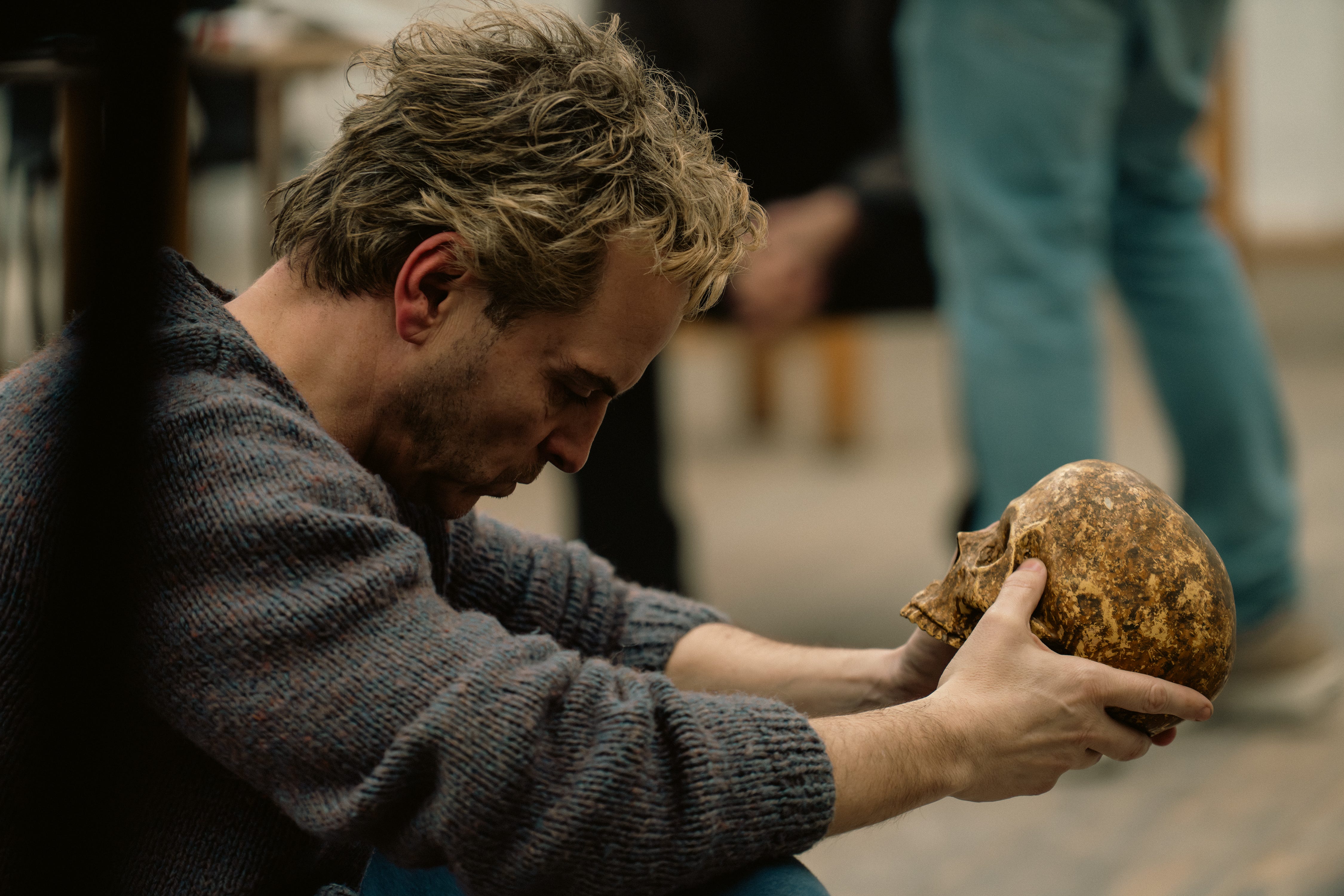
Andrew Scott shares the harsh reality of playing Hamlet

Alas, poor Yorick. Andrew Scott knew him. Well, some of him.
The Irish actor held Yorick’s skull – the famous memento mori from “Hamlet” – in a 2017 stage production of the Bard’s play in London and also
wields it in the true-life drama “Elsinore.” Two different skulls, but both with a ton of emotional weight.
“Every Hamlet has his own skull,” Scott says of Yorick, who in “Hamlet” is the title character’s dead court jester friend. “It’s terrifying to think of somebody that you knew and you had laughed with and loved, to just see them without any of the other things in it.”
Join our Watch Party! Sign up to receive USA TODAY's movie and TV recommendations right in your inbox
Scott has put together a rich canon of roles, from the villainous Moriarty of “Sherlock” and Hot Priest of “Fleabag” to a World War II meteorologist in “Pressure.” He hasn’t portrayed many actors in his career, which offered a different challenge as Ian Charleson of “Elsinore” (in select theaters now, nationwide Dec. 4), but he’s sensational enough to be one of the best actor favorites heading into next year’s Academy Awards.
Charleson, a gay Scottish actor who starred in “Chariots of Fire” and was also a noted stage thespian, was diagnosed with AIDS and dying when he was tapped to replace Daniel Day-Lewis in a high-profile production of “Hamlet” in 1989 at London’s Royal National Theatre. Charleson juggles tiring rehearsals and HIV treatments while experiencing both hilarious and heartbreaking moments. (The real Charleson managed to do 24 performances in the fall of '89, and died on Jan. 6, 1990, at age 40.)
Rather than a conventional biopic, "Elsinore" (named for the castle setting in "Hamlet") is "a very particular slice of his life,” Scott says. It was important to capture Charleson’s “joie de vivre at a time when things were pretty bleak for him and also in the world at large. But he had this sort of indomitable spirit and he was so full of fun and bravery, actually.”
British screenwriter Stephen Beresford studied acting as a schoolboy in the ‘80s and was aware of Charleson being an “incredible” performer. He says Charleson and Scott have in common the fact that they’re “witty” actors where “there could be a sparkle in a line that is incredibly heartbreaking. That wonderful tension between the two, which is actually how we all really live.”
“Elsinore” makes playing Hamlet look like the most brutal part an actor could ever do. In real life, “it's worse,” Scott acknowledges. “It is really genuinely the most exhausting part because, well, chiefly the length of it. It's three hours and 50 minutes, and you're doing it eight times a week. And you're talking so much – you have 5,000 lines [in the play] – and you have a sword fight in the third hour, and you're required to be the grieving son, an orator, a soldier, a member of the royal family. It's deeply personal but it's also completely epic.”
By the end of Scott’s real-life “Hamlet” run, “I was counting down the days, to be honest, just keeping your stamina up,” he adds. “Ian did it when he had no stamina at all, he had no immune system, and his face at that stage was altered. People would have maybe taken a second to even recognize him when he came on stage. And that to me is unbearably moving and extraordinarily courageous because I'm sure he was aware that there might have been whisperings in the audience.”
Scott did get to pick his own skull for “Elsinore” from “a whole plethora” of them: “The bits of the skull have to break off and stuff, so there's lots of things to consider." Real human skulls are actually used in performances of “Hamlet” – Beresford mentions one was donated to the Royal Shakespeare Company – and Scott considered one for “Elsinore.”
“It ended up being too small or looking too small,” Scott reveals. “That sounds sort of preposterous. It's kind of freaky, actually. I've worked with a couple of people that felt like I was acting with a skull.”
One of Beresford’s favorite moments in “Elsinore” occurs when Scott is holding the skull in the film “and he does something where he shields the skull's eyes and looks away because he can't bear the gaze of the dead,” the writer says. “That's not on the page. That's just his genius.”
That was all “instinct,” Scott confirms. “It’d be a bit creepy thinking this is what I’d do the whole time.”
Scott winning an Oscar would be a historic moment: No publicly out gay actor has ever won the best actor category. “I really do believe that old Hollywood saying, which is nobody knows anything. You have to really genuinely take it with a pinch of salt,” Scott says. While he does appreciate the extra buzz for the movie, “you can't really attach too much stuff to it.”
After turning 50 last month, Scott feels there’s “so much more” growth to be had as an actor. “When you're thinking about acting, you go, ‘How do I not trot out the same old simple thing that I sort of go to?’ ” he says, adding his goal now is to mine new ground. “I’ve never been in a horror film, and I think I'd be a great scream queen!"