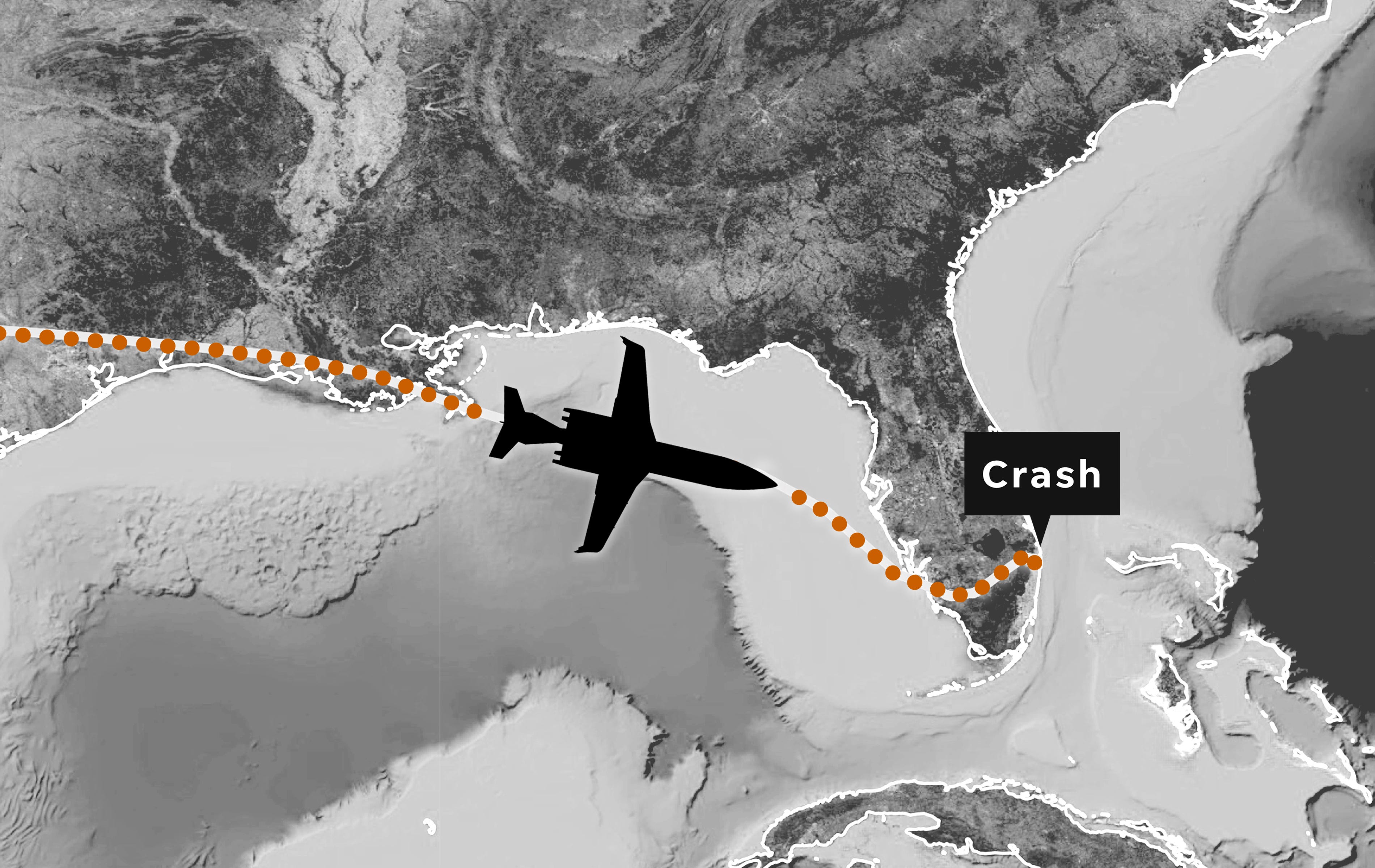
Moment by moment, how a Learjet passenger plane crashed in Florida

Federal aviation officials are investigating the cause of the fatal crash of a Learjet 60 business plane that nosedived and exploded on impact in Florida, killing all nine people on board on Nov. 1.
jet crashed near Greenacres in Palm Beach County, leaving a burning crater and a massive debris field. No one on the ground was reported injured.
The private jet left Austin-Bergstrom International Airport in Austin at about 10:37 a.m. ET, bound for the North Eleuthera airport in the Bahamas, according to the Federal Aviation Administration.
The plane flew into an explosive thunderstorm that rocketed clouds skyward by 15,000 feet in 20 minutes, the USA TODAY Network reported. That may have led to the rapid freezing of water droplets, hampering the plane's ability to maneuver.
.oembed-frame { width: 100%; height: 100%; margin: 0; border: 0; }
Can't see our graphics? Click here to reload the page.
National Transportation Safety Board member Tom Chapman said at a news conference Nov. 2 that there is evidence the aircraft began breaking up before impact. Investigators are still working to determine exactly what happened.
The aircraft was over Florida when the crew reported light ice and moderate air turbulence. Less than two minutes later, the crew declared a mayday and said the aircraft was descending at 10,000 feet per minute.
The plane crashed a minute later.
.oembed-frame { width: 100%; height: 100%; margin: 0; border: 0; }
.oembed-frame { width: 100%; height: 100%; margin: 0; border: 0; }
Minute by minute, what happened to the aircraft?
All times are approximate. Aircraft position and flight data are from Flightradar24; communications and their approximate timing are based on Miami Center audio archived by LiveATC.net and reproduced in this timeline video.
12:47 p.m.: The Learjet is at an altitude of about 35,000 feet when the crew reports “light clear ice that is manageable and moderate turbulence.” The crew says the outside air temperature is -47 degrees Celsius, or -52.6 degrees Fahrenheit. 12:48 p.m.: The crew reports the aircraft is encountering precipitation and requests a new altitude of 37,000 feet. Air traffic control in Miami Center clears the aircraft to climb. 12:48:28 p.m.: About 30 seconds later, the crew declares Mayday and says the plane is descending 10,000 feet per minute. 12:48:33 p.m.: The crew says: “We are in an overspeed condition,” reporting a descent of 20,000 feet per minute. (An overspeed condition occurs when an aircraft exceeds its maximum permitted speed.) 12:48:53 p.m.: “We’re going to crash into the ground,” the crew says. 12:49:08: p.m. “We are descending 22,000 feet and we are banking 60 degrees,” the crew says. (Banking 60 degrees means the aircraft is rolling steeply to one side.) 12:49:22: p.m. “We’re out of time,” the crew says. It is the last transmission from the aircraft. 12:50 p.m.: The aircraft crashes.
.oembed-frame { width: 100%; height: 100%; margin: 0; border: 0; }
Contributing: Christopher Cann, John Bisognano, Tom Elia, Natalie Neysa Alund, Kimberly Miller
Source: USA TODAY Network reporting and research; Reuters; Flightradar24