Former U.S. Olympic Canoeist David Hearn Arrested for Alleged Vandalism at Lincoln Memorial Reflecting Pool

What's Happening?
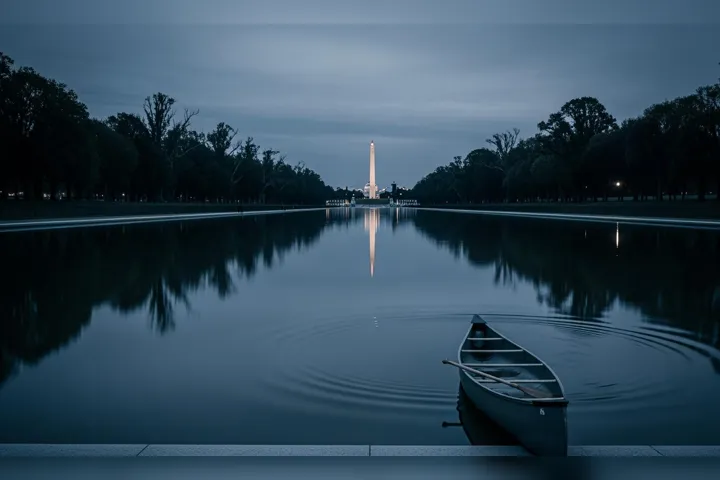
David Hearn, a former U.S. Olympic canoeist, was arrested in Washington, D.C. for allegedly vandalizing the Lincoln Memorial Reflecting Pool. The incident occurred as Hearn was cycling past the monument and noticed a piece of the pool's liner floating in the water. He claimed to have reached out to touch the detached piece, which led to his arrest by Park Police. President Trump commented on the incident, stating that the vandals used chemicals that damaged the pool, which had recently undergone a $14.8 million restoration. The pool's liner, intended to be 'American flag blue,' has been deteriorating due to an algae bloom. Hearn, who denies any wrongdoing, was detained for nearly five hours and is scheduled to appear in D.C. Superior Court on July 9.
Why It's Important?
The arrest of David Hearn highlights ongoing issues with the maintenance and preservation of national monuments. The Lincoln Memorial Reflecting Pool, a significant historical site, recently underwent costly renovations, and its current state raises concerns about the effectiveness of these efforts. The incident also underscores the challenges faced by authorities in protecting public property from vandalism. The involvement of a former Olympian in such an incident draws public attention and may influence future security measures at national landmarks. Additionally, the situation reflects broader societal issues regarding respect for public spaces and the consequences of alleged vandalism.
What's Next?
David Hearn is set to appear in court on July 9 to face charges of destruction of government property. The outcome of this case could set a precedent for how similar incidents are handled in the future. Authorities may consider increasing security measures around national monuments to prevent further vandalism. The Trump administration's efforts to restore the Reflecting Pool to its intended appearance will likely continue, with potential adjustments to the restoration process to address the algae problem. Public and media attention on this case may also prompt discussions about the preservation of historical sites and the responsibilities of individuals in maintaining public property.
AI Generated Content
For the benefit of users - Parts of this article may include content generated using AI tools. Our teams are making active and commercially reasonable efforts to moderate all AI generated content. Our moderation processes are improving however our processes are carried out on a best-effort basis and may not be exhaustive in nature. We encourage our users to consume the content judiciously and rely on their own research for accuracy of facts. We maintain that all AI generated content on our platform is for entertainment purposes only. To know more about how we use AI, you can write to us at
Close AI Generated Content