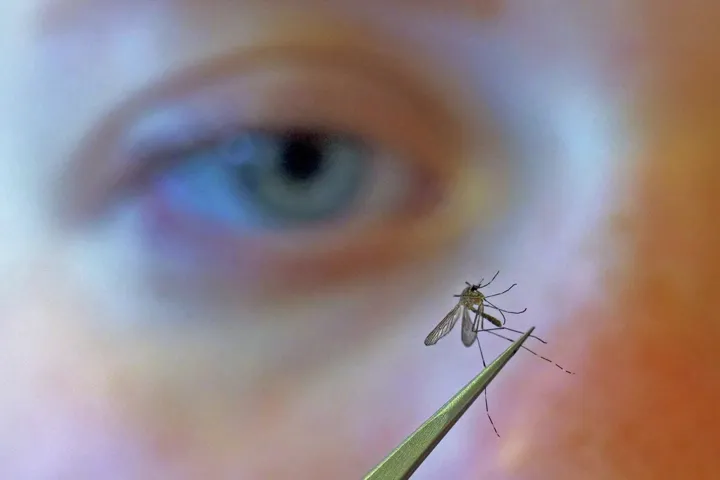
CDC urges people to prevent mosquito bites as West Nile virus season hits a strong, early start

Health officials are encouraging people to use bug spray and mosquito-control efforts as West Nile virus season is off to its earliest and worst start in over two decades.
The Centers for Disease Control and Prevention said Wednesday that it had confirmed at least 48 cases — 38 of them severe — as of June 30. Since 2004, the average number of cases reported to the CDC by the end of June is around 10. Federal health officials said 23 states have reported finding West Nile virus, the most in 10 years.
“These findings serve as an important reminder that mosquito season is well underway,” said Dr. Erin Staples, a CDC expert on insect-borne diseases. “As families gather outdoors to celebrate Independence Day, we encourage everyone to enjoy their holiday while taking simple steps to protect themselves and their loved ones from mosquito bites.”
Most of the cases have been in Arizona. Of the state's 32 total cases, 29 are in Maricopa County. The county, which includes Phoenix, has also recorded four deaths from the virus so far this year.
Officials there asked people to wear bug spray containing DEET, patch up broken window screens and get rid of standing water, where mosquitoes often breed.
“Even an overturned bottle cap can hold enough water for mosquitoes to breed,” said Melissa Kretschmer, a county health department official. “It’s important that we remove these breeding sources that can form after rain or watering plants.”
The CDC also recommends people wear long, loose-fitting clothes when outside to make it harder for mosquitoes to bite them. Experts also suggest people avoid being outdoors around dusk and dawn, when the mosquitoes that carry the virus are most active.
West Nile virus was first reported in the United States in 1999 in New York, and then gradually spread across the country. It peaked in 2003, when nearly 10,000 cases were reported.
Scientists say many people — perhaps tens of thousands each year — are infected but don’t know it because they have no symptoms, or only mild ones such as headaches, body aches, joint pain, vomiting, diarrhea and rashes.
In severe cases, damage to the central nervous system causes potentially deadly inflammation of the brain or spinal cord. Adults older than 60 and people with underlying medical conditions or weakened immune systems face the highest risk of such complications.
In the last decade, health officials have fielded reports of 2,000 cases annually on average, including 1,200 life-threatening neurological illnesses and about 100 deaths.
___
The Associated Press Health and Science Department receives support from the Howard Hughes Medical Institute’s Department of Science Education and the Robert Wood Johnson Foundation. The AP is solely responsible for all content.