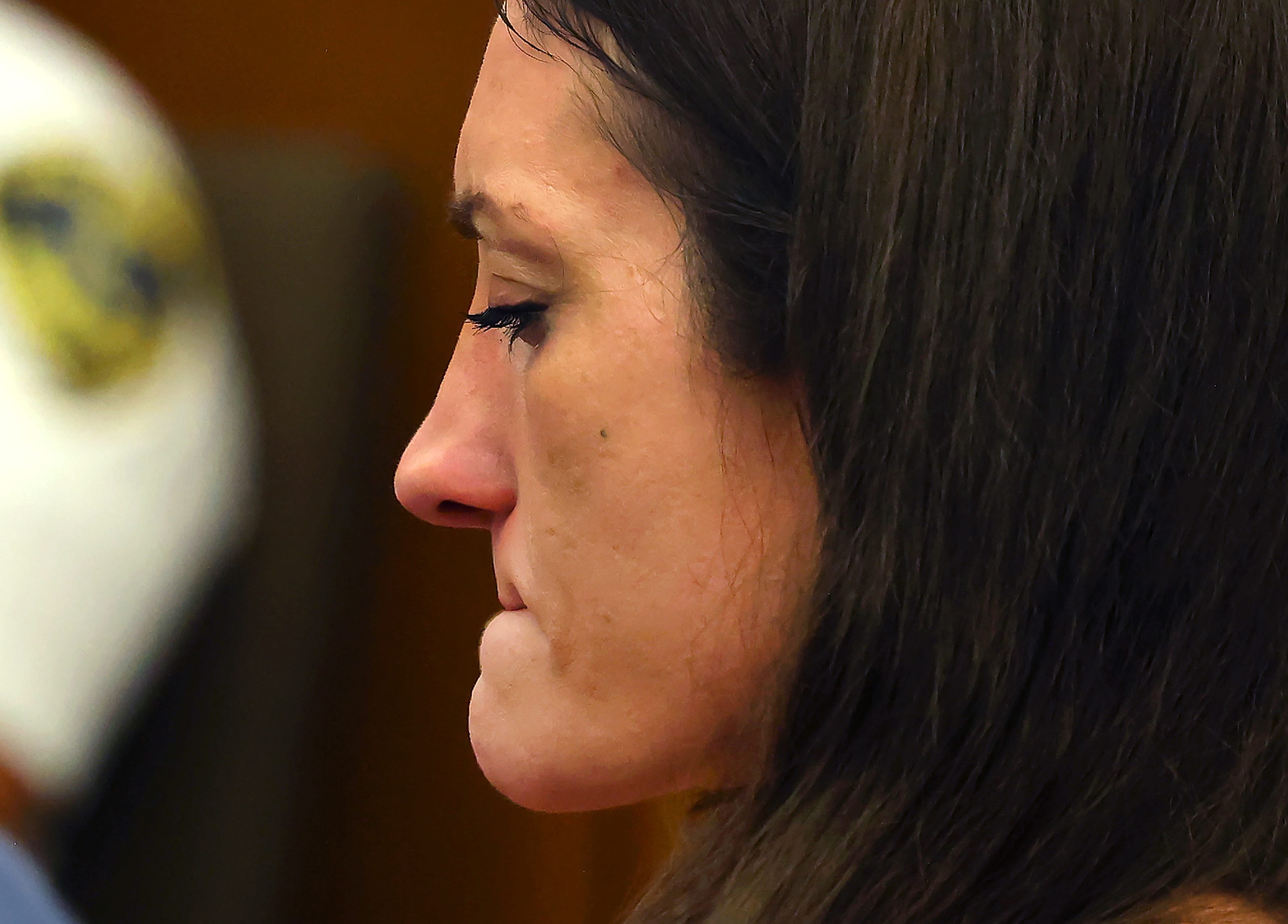
I checked into a mental health hospital to save my kids | Opinion

About a month after my youngest child was born, I drove myself to a behavioral health hospital, fighting the urge to wrap my car around a tree every mile of the way.
I didn’t decide to make that drive because
I didn’t love my new baby or because I didn’t love my other children or because I didn’t know how lucky I was to have them (a privilege denied to many, which is not lost on me). But I was terrified I was going to hurt myself – or, worse, them.
The unspoken rule of new motherhood is that if something feels wrong about your circumstances, something is wrong with you. Love and gratitude should be the dominant emotions you feel. You wanted this baby. You grew this baby inside of you. How can you be anything but overjoyed?
But more than one thing can be true at once – I was both profoundly grateful for my children and profoundly unwell. I both loved my baby and wanted nothing more than to get far away from him.
Reaching a breaking point
This bout of postpartum depression came as the second year of the pandemic came to a close. I was juggling an essential worker husband who was gone long hours for days at a stretch, two other kids besides the newborn and an aging parent who needed caregiving. I was not eating well. I was, as all new moms are, sleep-deprived. I wasn’t really doing much of anything for myself except trudging along and occasionally remembering to take a sip of water.
For someone who had, before this pregnancy, been accustomed to managing a hundred things at once and making it look easy (or so I’d been told), the sudden inability to manage even the smallest of tasks was frightening. I couldn’t stay on top of the laundry. I couldn’t go to the store for new clothes when the baby outgrew his newborn stuff. Just keeping all three of the kids semi-fed and semi-clean took more than I had. Keeping myself clean and fed was out of the question entirely.
Opinion: Christa Pike case shows Tennessee can't get executions right
I cannot identify a particular moment when I reached a breaking point. Each day got progressively worse than the one before until I woke up one morning and knew, with alarming certainty, that I needed more help than the low-dose antidepressants my OB-GYN’s office had given me a week or so prior. I called a suicide hotline. Though I didn’t have a plan in place, they took me very seriously and gave me directions to the nearest inpatient mental health facility.
We tell mothers to ask for help as though asking is the hard part. But as difficult as asking might be, accepting the help is where the true difficulty lies. Because in order to accept the help, we have to relinquish what we’ve been fighting so hard to control, trust that someone else knows what’s best for us and admit a really hard truth: “I’m afraid of what I might do to myself, or my children.”
Mothers need better mental health support
Lindsay Clancy’s caseforces us to confront what happens when that truth is admitted and the systems in place are still not enough to prevent tragedy. Though Clancy fell on the extreme end of postpartum mental illness (only about 2 in 1,000 women experience postpartum psychosis), the tragedy that befell the Clancy children shows that we are not doing enough for struggling moms much earlier in the chain.
My story is not one of postpartum depression magically resolving itself after a few days’ stay in an inpatient facility. (It took months to fully overcome, but the inpatient stay stabilized me in a way I had no hope of achieving without it.) It’s a story of asking for help and getting the exact kind of help I needed, at the exact time I needed it – and, most importantly, being sent home with the right medicines, prescheduled therapy appointments, coping mechanisms and, should I feel the need to return, the promise of open arms and a waiting bed, no questions asked.
Opinion: Common sense rules to regulate Flock | Opinion
Somewhere between 10 and 15% of mothers experience postpartum depressionand/or anxiety, according to the National Institutes of Health. Yet, until they know there is an infrastructure in place to properly respond to such a difficult disclosure, we can’t expect struggling moms to tell others that they cannot keep their heads above water.
I, thankfully, encountered such an infrastructure. However, over 130 million Americans live in an area with a shortage of mental health professionals. That statistic is even more grim for those experiencing maternal mental health crises: 84% of birthing-aged women live in shortage areas, with Tennessee being one of a handful of states facing the largest risk and resource gaps.
Slashing the stigmas of mental health treatment
We also have much work to do in overcoming the stigma attached to extreme forms of mental health, like inpatient treatment. For years, my weeklong stay in a mental health hospital was my darkest secret. I lived in fear of my small-town Tennessee existence being thrown into upheaval if word got out that I had once been in a “psych ward.”
Somewhere along the way, though, it dawned on me that I could not be both ashamed of my experience and an advocate for erasing the stigma. So I made the decision to step into the light and say, “It happened to me. It’s okay if it happens to you, too. What matters is not what society has taught you to believe about new motherhood and mental hospitals, but that you are doing what is best for you and your children.”
Opinion: Christa Pike's botched execution is a moral stain on America
Going to a mental health hospital did not mean I was “crazy.” It meant I was a good mother trying to be an even better one, one who was safe and stable for her children.
Mothers need to know that when they finally feel it’s time to say, “I’m not okay,” someone will believe them, take them seriously and have somewhere safe to send them.
I hope we are on the path to building a society where no mother feels ashamed to make that admission – and where, when she does, there is always somewhere safe for her to go.
Ashley L. Hall is a writer and legal researcher living outside of Chattanooga with her husband, four children and three pet rabbits. She is passionate about maternal mental healthcare and has recently finished a book detailing her lived experience with postpartum depression and the inpatient treatment she received to get through it (publication forthcoming). Her first book, “The Hall Monitor: Hilarious Tales of Parenting,” is available at amazon.com and bn.com.