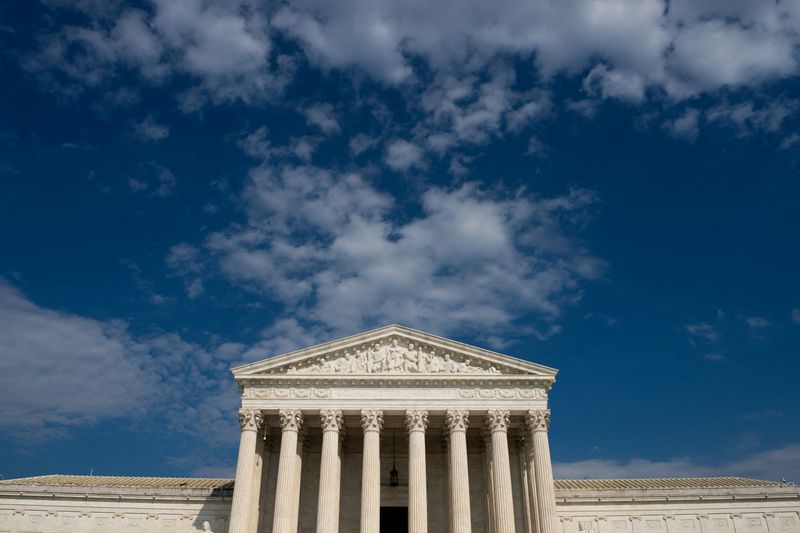
US Supreme Court leans toward Catholic preschools' challenge to LGBT protections

By John Kruzel
WASHINGTON, Nov 3 (Reuters) - Conservative US Supreme Court justices appeared sympathetic on Tuesday toward a challenge by Catholic groups to a Colorado law barring anti-LGBT discrimination
at publicly funded preschools in a case that could further bolster the rights of religious people and institutions.
The court, whose 6-3 conservative majority has taken a broad view of religious liberty, is considering a bid by the Archdiocese of Denver and other Catholic entities for an exemption from a Colorado preschool funding program's nondiscrimination requirement. Republican President Donald Trump's administration is backing the Catholic groups.
Officials in Democratic-governed Colorado have accused the Catholic preschools of seeking legal permission to discriminate against 4-year-olds and their families while receiving taxpayer dollars under the state's universal preschool program. Lower courts upheld the program's protections for LGBT people.
The case gives the Supreme Court another opportunity to expand a provision of the US Constitution's First Amendment called the Free Exercise Clause, which protects the right to practice religion without government interference. The court's liberal justices have criticized the conservative majority in recent cases for undermining the separation of church and state.
The conservative justices seemed inclined to view the Free Exercise Clause as requiring protection not only against explicit discrimination against religious groups, but also against certain laws that have such an effect.
The archdiocese oversees 34 Catholic preschools, according to court papers. Its policy is to admit students only from families who support Catholic beliefs, including on same-sex relationships and gender identity.
"The Archdiocese of Denver schools exist to pass on the faith to the next generation," Nicholas Reaves, a lawyer for the Catholic groups, told the justices.
"To do this, they ask all families who enroll to be open to and supportive of the Church's teachings. Because of this sincere religious exercise, the state has denied Colorado families the ability to use universal preschool funding at Catholic schools," Reaves said.
Some justices, including conservative Chief Justice John Roberts and liberal Justices Elena Kagan and Sonia Sotomayor, expressed skepticism toward the argument by Reaves that the court's prior decisions favoring religious schools should dictate a similar outcome in favor of the Catholic preschools.
"The law in those cases, in each of them, expressly discriminated against religious schools on its face," Roberts told Reaves. "That's not the case here."
Kagan told Reaves that a key prior ruling "upheld a very different principle" than what he is arguing for. That earlier case, Kagan said, stands for the principle that "you can't treat religious institutions differently."
"That's not the principle that's at issue here," Kagan said. "The principle at issue here is: Do you have to treat them better?"
Helen Norton, a lawyer representing Colorado officials, told the justices the state's universal preschool program is "neutral towards religion."
"Colorado welcomes religious preschools to (the program). The only thing Colorado asks is that they comply with the same conditions that every publicly funded preschool must meet, religious and secular alike."
Liberal Justice Ketanji Brown Jackson told Reaves that "it seems to me you're asking for a special rule for religious schools — that when Colorado says anyone who receives these funds has to be open to everyone and can't discriminate, what you're asking for in the context of this Free Exercise claim is a special rule for religious schools to be able to not follow that condition."
The First Amendment's Establishment Clause — the constitutional underpinning of church-state separation — restricts the government from establishing or endorsing any particular religion, or promoting religion over nonreligion. It is not directly implicated in Tuesday's case.
Conservative religious interests in recent years have prevailed in a series of cases at the court pitting religious rights against LGBT protections.
Norton said the Colorado program holds all participating preschools to the same standards, including equal opportunity.
"Under this program, faith-based preschools remain free to teach their religious beliefs, including their beliefs about sex or gender or marriage, free to teach them while receiving public funding," Norton said.
'EQUAL OPPORTUNITY'
Colorado children in 2023 became eligible under state law for 15 hours per week of publicly funded preschool before entering kindergarten. Participating preschools may be public or private, secular or religious. But in each case, under the law, schools must give all children "equal opportunity" to enroll, regardless of the sexual orientation or gender identity of the students or parents.
The Archdiocese of Denver along with other Catholic entities and a Colorado family sued as the state's universal preschool initiative was ramping up. They argued that the program's anti-discrimination mandate burdened their religious exercise.
The Catholic Church recognizes marriage as a union only between a man and a woman, not same-sex couples, and opposes transgender self-identification. The Catholic Church's catechism, a compendium of its teachings, also states that "homosexual acts are intrinsically disordered" and that "under no circumstances can they be approved."
Sarah Harris, a Justice Department lawyer, argued in favor of the appeal by the Catholic groups. Sotomayor at one point told Harris, "What you're basically saying is, we can exclude people merely because exposure to them would cause us harm."
A core disagreement in the case is whether Colorado discriminated against the Catholic preschools by refusing to exempt them from the equal-opportunity requirement, while at the same time allowing preschools to prioritize the enrollment of low-income and disabled students.
"Colorado has flexibly interpreted the mandate to accommodate important secular interests, but it's called the same law a hard limit when petitioners (the Catholic groups) sought a religious accommodation," Reaves told the justices.
Colorado has argued that its equal-opportunity requirements do not intrude on the Free Exercise Clause because they are neutral and apply generally to participating groups.
Colorado bases its argument on a 1990 Supreme Court precedent in a case called Employment Division v. Smith that upheld "generally applicable" laws even if they curb religious freedom. That ruling has long been in the crosshairs of conservative litigants.
A ruling is expected by the end of June.
(Reporting by John Kruzel; Editing by Will Dunham)