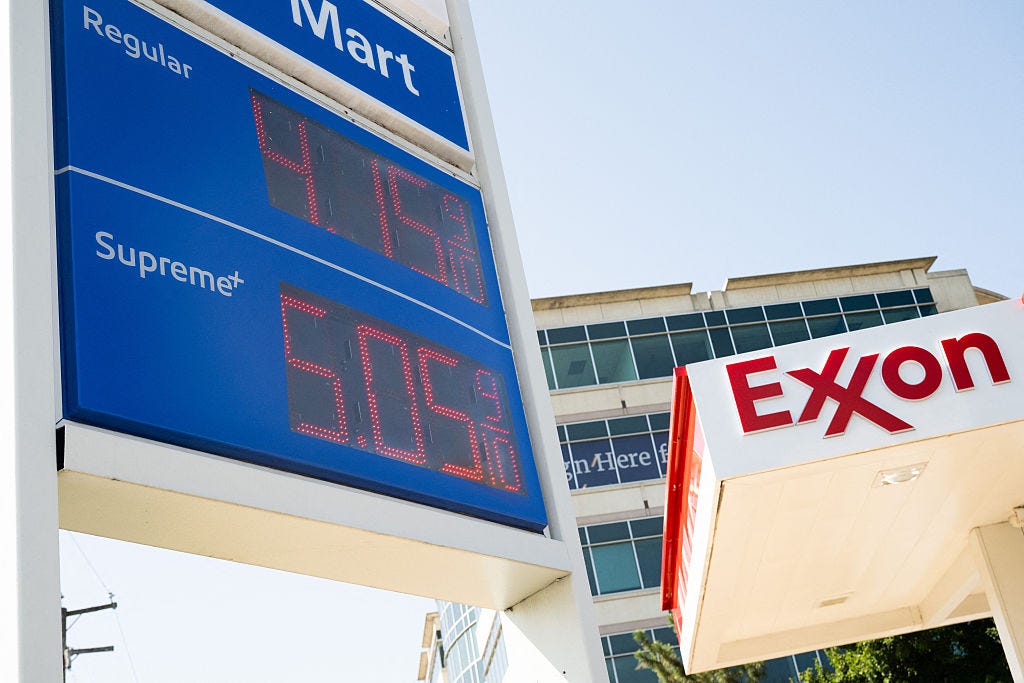
Will a gas-tax holiday actually lower gas prices?

Several states are pushing to suspend or eliminate their gas taxes to help drivers suffering from high prices at the pump due to the Iran war. There's also been a push to suspend 18-cent-per-gallon federal
gas tax. But critics say neither would do much to lower prices at the pump that have increased more than $1-per-gallon since the war began.
President Donald Trump has called for a temporarily suspension of the 18-cent per gallon federal gas tax, and some U.S. lawmakers and auto industry lobbyists have agreed.
Trump said in a telephone interview with a CBS News reporter in May that he thinks it would be a "great idea" to temporarily lift the gas tax.
Elsewhere, Georgia Governor Brian Kemp, a Republican, announced a one-month suspension of his state's 33 cent local gas tax on Sept. 28. Other states like Indiana, Ohio, Alabama, Louisiana and Texas have either initiated or considered gas tax holidays.
"Today, I’m again suspending the state gas tax to help families and small businesses at the pump," Kemp, a Republican, said in an X Sept. 28 post.
Over the last few years, we’ve partnered with the General Assembly to provide billions of dollars of relief for hardworking Georgians. Today, I’m again suspending the state gas tax to help families and small businesses at the pump.https://t.co/hGKopbG7TX pic.twitter.com/GpjgtZKXyz
— Governor Brian P. Kemp (@GovKemp) September 28, 2026
"Today I announced another gas tax extension with additional relief for farmers," Indiana Governor Mike Braun, a Republican, added in a Sept. 30 X post announcing an extension of his state's gas tax holiday that he said will last until early November.
The state gas tax suspensions are coming as the national average gas price was $4.41 per gallon on Oct. 1, according to AAA. That figure is up from a national average price of $4.09 one month ago on Sept. 1, 2026 and an average of $3.16 one year ago on Oct. 1, 2025.
Why are states moving to suspend their gas taxes?
States are scrambling to suspend their gas taxes because gas prices have remained over $4-per-gallon most of the year, and voters keep telling pollsters they are furious about it.
Kemp, the Georgia governor, pointed out that his state has suspended its gas tax several times this year in a bid to help consumers.
“Over the past several years, with the help of our partners in the General Assembly, we've been able to give billions of dollars in relief to hardworking Georgians,”Kemp said in a statement announcing the move, which is Georgia's third gas tax suspension this year.
Braun, the Indiana governor, said he extended his state's gas tax suspension an additional month for farmers in a bid to help Indianans in agriculture.
"The added cost of fuel prices caused by continued disruptions to the global oil supply can make a major difference in our farmers’ success and their ability to put food on the table for their families," Braun said.
Today I announced another gas tax extension with additional relief for farmers. Our farmers have the hardest job in America. The added cost of fuel prices caused by continued disruptions to the global oil supply can make a major difference in our farmers’ success and their…
— Governor Mike Braun (@GovBraun) September 30, 2026
Gas and oil industry analysts have said any relief for state-level gas tax suspensions will be modest at best.
"More states eager to try and bring small to moderate relief to gasoline and diesel prices ahead of the mid-terms," Patrick De Haan, Head of Petroleum Analysis at GasBuddy, said in an X post. "We're tracking various levers being pulled or attempted in TX, IN, GA, KY, UT, OH, MA, MS, AL, LA, OK, ND, NE, SD."
But De Haan said relief doesn't come to drivers as soon as governors finish swiping their pens.
"As stations buy fuel every 2-4 days there will be a lag to how quickly some stations start to lower price," he said.
How much is the federal gas tax and what is used for?
The federal government has been collecting taxes on every gas purchase made at a U.S. station since the 1930s. The current rate of 18.4 cents per gallon was established by a law that was passed by Congress in 1993. Transportation funding advocates have lamented the fact that Congress has not moved to increase the gas tax in more than three decades.
The federal gas tax was first established in 1932 at a rate of 1 cent per gallon. Congress has approved increases multiple times since then, and some lawmakers have called to tie the tax to inflation as votes to increase taxes have become politically difficult for lawmakers who are up for election.
The gas tax is typically authorized by Congress each time it adopts a federal highway funding bill because the revenue it generates is used to fund the Department of Transportation’s Highway Trust Fund. The Highway Trust Fund is distributed to states to help pay for road and transit construction projects.
As cars have become more fuel-efficient and more drivers have opted for electric vehicles and hybrids, the government has collected less money despite increased use of roads. Lawmakers have been looking for ways to close that growing gap in federal gas‑tax revenue.
What would it take to eliminate or suspend the US gas tax?
A suspension or elimination of the federal gas tax would require an act of Congress since the collection of the levy was authorized by lawmakers in previous highway funding bills.
The idea is being floated now because the current federal highway funding bill, which was included in former President Joe Biden's signature bipartisan infrastructure bill that was passed in 2021, was set to expire on Sept. 30. Congress passed a temporary extension of the measure that last until early December, but the expectation remains that lawmakers will ultimately pass an entirely new transportation funding bill.
The last time Congress took a vote to do anything other than reauthorize the gas tax at its current 18.4 cents-per-gallon level was 1993.
Since the tax was first implemented at a rate of 1 cent per gallon in 1932, Congress has voted to increase the fuel levy nine times, including the most recent vote in 1993, according to the Congressional Research Service.
In that same time span, lawmakers have only voted twice to lower the federal gas tax, once going from 1.5 cents per gallon to 1 cent per gallon in 1934 and once going from 9.1 cents per gallon to 9 cents per gallon in 1987.
Congress has debated ideas about temporarily suspending the gas tax at times of high fuel prices, or scrapping it altogether in favor of plans to tax drivers based on the number of miles they drive or their car's weight; those proposals often raise concerns about infringing upon drivers' privacy.
Congress has never voted to rescind the tax since it was first authorized it in 1932.
Which states have the highest gas taxes?
On top of the 18-cent federal gas tax that every driver pays each time they fill up their tanks, each state tacks on its own local gas tax.
Here are the top 5 states with the highest gas taxes, including the federal tax, according to the Tax Foundation, and their current gas price averages, according to AAA:
1. California Gas Tax: 74 cents per gallon Oct. 1 Gas Price Average: $6.40 2. Illinois Gas Tax: 70 cents per gallon Oct. 1 Gas Price Average: $$4.71 3. Indiana Gas Tax: 63 cents per gallon Oct. 1 Gas Price Average: $4.50 4. Washington Gas Tax: 60 cents per gallon Oct. 1 Gas Price Average: $5.49 5. Pennsylvania Gas Tax: 59 cents per gallon Oct. 1 Gas Price Average: $4.50
Keith Laing is an automotive reporter on the National Trending Desk at USA TODAY. Contact Keith at klaing@usatodayco.com.