Across the South, Black voters weigh a new political reality

When the U.S. Supreme Court threw out a Black-majority congressional district in Louisiana this year, it also severely weakened a landmark Civil Rights-era law that has increased minority representation
in Congress.
Spurred by President Donald Trump in the wake of the court’s decision, Southern states redrew their voting maps, seeking to make them more winnable by Republicans. In the process, they eliminated other majority Black congressional districts ahead of this year’s midterm elections, when political control of Congress will be at stake.
The reverberations are still being felt across the South, where memories of the Civil Rights Movement and the genesis of the 1965 Voting Rights Act are still fresh.
Related: In Louisiana, a new voting rights fight takes shape as midterms loom
Critics have blasted the court’s decision and resulting redistricting as retrograde, while proponents have hailed them as commonsense.
To illuminate the impact, USA TODAY Network reporters fanned out across six cities in five Southern states. Here is what they found.
Read more: Memphis, Tennessee | Nashville| Baton Rouge, Louisiana | Orangeburg, South Carolina | Montgomery, Alabama | Natchez, Mississippi
Memphis, Tennessee
!function(e,n,i,s){var d="InfogramEmbeds";var o=e.getElementsByTagName(n)[0];if(window[d]&&window[d].initialized)window[d].process&&window[d].process();else if(!e.getElementById(i)){var r=e.createElement(n);r.async=1,r.id=i,r.src=s,o.parentNode.insertBefore(r,o)}}(document,"script","infogram-async","https://e.infogram.com/js/dist/embed-loader-min.js");
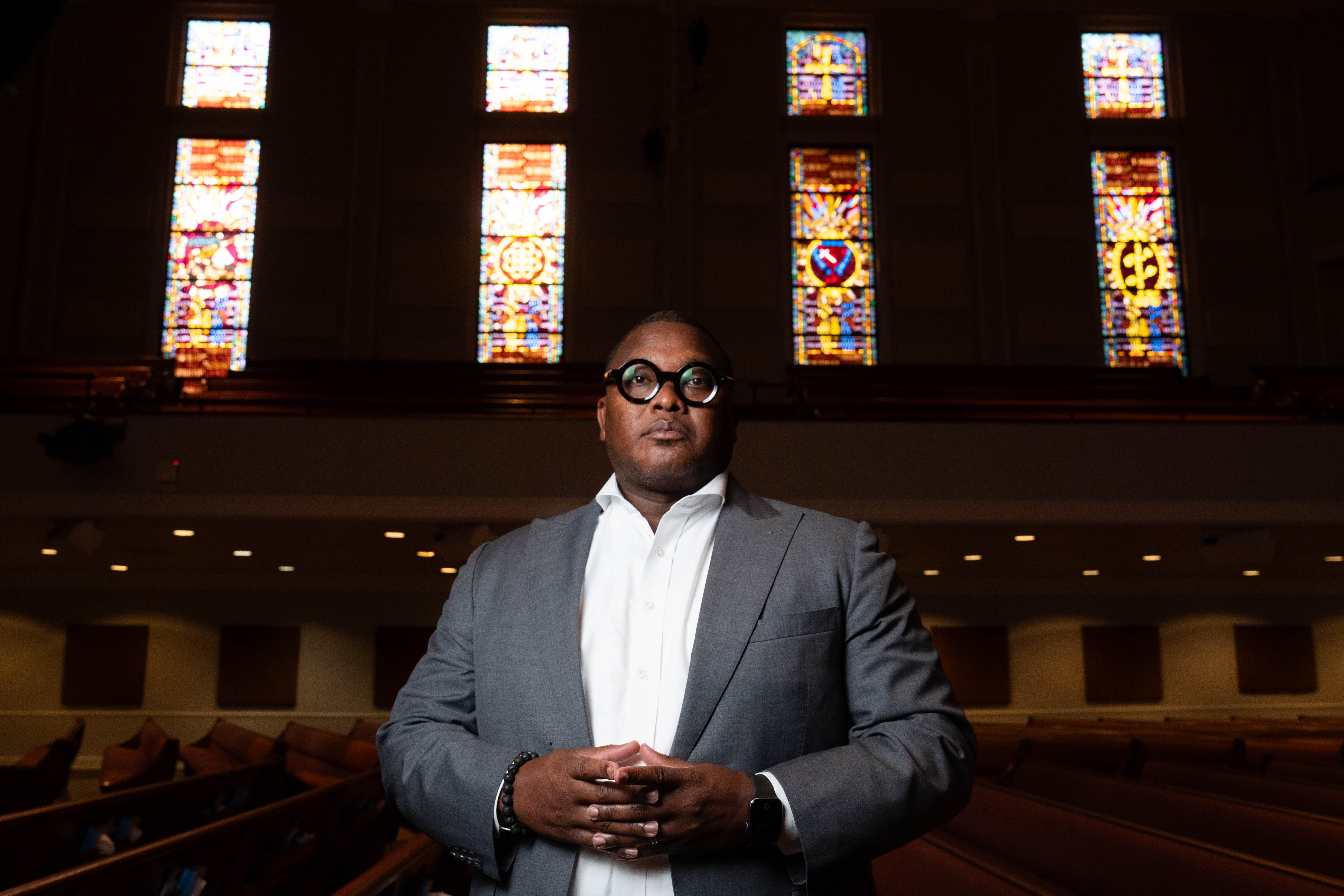
J. Lawrence Turner brought worshippers to their feet this month at Mississippi Boulevard Christian Church in Midtown Memphis when he urged them to “get off their blessed assurance and vote.”
“The time is now. The need is urgent. The opposition is great,” Turner said between interludes from a choir swaying behind him. “But greater is 'He' who lives on the inside of us than 'He' that's in the world."
Just two days after the Supreme Court ruling, Tennessee Republican Gov. Bill Lee announced plans for a special legislative session.
“We owe it to Tennesseans to ensure our congressional districts accurately reflect the will of Tennessee voters,” Lee said. “I believe the General Assembly has a responsibility to review the map and ensure it remains fair, legal, and defensible.”
The Republican-controlled state Legislature then redrew the state's congressional map, eliminating a majority-Black district in the Memphis area. The city is now split into three districts, all of which are designed to be GOP-leaning.
Turner said he could not remember another time when so many people in his community were engaged in politics.
"People feel disregarded and disrespected," he said. "It was a very clear attempt to break up, not just Democratic power, but Black political power."
Churchgoers that Sunday in September wore T-shirts emblazoned with "Voting is my Black job."
Turner has spearheaded efforts to turn out the vote both at home in Memphis and throughout Tennessee. He works with the African American Clergy Collective of Tennessee, which distributes election-related information to congregants and organizes early-voting groups. Teaming up with the Black Clergy Collaborative of Memphis and other local groups, Black church leaders have also mobilized volunteers to phonebank, canvas door to door and send tens of thousands of postcards to registered voters.
"Yeah, the deck has been stacked against us," Turner said. "But if we really do the work ... we can still choose who represents us."
− Annie Goldman, The Commercial Appeal
Nashville, Tennessee
!function(e,n,i,s){var d="InfogramEmbeds";var o=e.getElementsByTagName(n)[0];if(window[d]&&window[d].initialized)window[d].process&&window[d].process();else if(!e.getElementById(i)){var r=e.createElement(n);r.async=1,r.id=i,r.src=s,o.parentNode.insertBefore(r,o)}}(document,"script","infogram-async","https://e.infogram.com/js/dist/embed-loader-min.js");
The words “Deceive, Disrupt, Deny” were projected on a classroom wall at Tennessee State University.
Organize Tennessee, a voter advocacy group, listed these concerns as part of an Aug. 29 “Democracy Summit” partly focused on the possibility of voter suppression during the upcoming midterms.
“We’re worried about voter intimidation, misinformation and confusion caused by redistricting,” Anna Dorman, counsel and clinical coordinator for Protect Democracy, said during the standing-room-only event. “This year, we’re prepared for threats from the actual federal government.”
Cicely Sharp of Memphis previously volunteered as a poll observer. But after her congressional district was splintered following the Supreme Court decision, she decided she needed to do more. Sharp applied for an open position as a Shelby County coordinator with Organize Tennessee, allowing her to work across the state.
“It was a really big blow, and I remember thinking, ‘OK, so what's next?’ How do we prepare?” she said. “I have to talk to my friends, my neighbors. I have to let people know we're in a new congressional district.”
“Initially, there was confusion and anger,” Sharp added. “But that has tempered down a bit as people recognize the seriousness of the moment.”
− Angele Latham, The Tennessean
Baton Rouge, Louisiana
!function(e,n,i,s){var d="InfogramEmbeds";var o=e.getElementsByTagName(n)[0];if(window[d]&&window[d].initialized)window[d].process&&window[d].process();else if(!e.getElementById(i)){var r=e.createElement(n);r.async=1,r.id=i,r.src=s,o.parentNode.insertBefore(r,o)}}(document,"script","infogram-async","https://e.infogram.com/js/dist/embed-loader-min.js");
Gary Chambers Jr. directed about 40 volunteers as they piled out of pickup truck beds on a recent summer night in Baton Rouge. The heat hovered near 100 degrees.
They knocked on doors, as they had done twice a week for much of the summer. And they did it in predominantly Black neighborhoods for Ryan Thompson, who's conducting a longshot campaign to unseat incumbent prosecutor Hillar Moore, who is white.
"People are energized, mobilized and ready to go to get us another seat of power to be able to dispense justice for our community," said Chambers, a community civil and voting rights activist.
That campaign, Chambers said, is a microcosm of what must happen to restore and amplify Black voting power throughout the nation.
The Supreme Court’s decision allowed Republican Gov. Jeff Landry and the GOP-controlled Legislature to draw a new congressional map, eliminating one of the state’s two majority-Black congressional districts. Landry has defended the new map, saying voters should no longer be sorted by race.
“The best way to end race-based discrimination is to stop making decisions based on race,” he said after the court’s ruling. “Here in Louisiana, we're proud to lead the nation on this charge."
But Chambers argues that the deck has been stacked against Black voters for generations, and that the rollback of the Voting Rights Act requires immediate action.
"Louisiana's population is one-third Black, and we've had four Black men in Congress since Reconstruction," he said. "I'm wise enough to know if an equation is that unbalanced, somebody is screwing my people."
Chambers is a social media sensation with a rising national profile that includes appearances on the popular "Stephen A. Smith Show" on SiriusXM radio. But he said social media platforms – "today's town square," as he described them – must be accompanied by old school boots-on-the-ground campaigns like the one he's leading in Baton Rouge.
"I'm chopping wood every day, not just on social media but riding my bicycle in these communities and knocking doors," he said. "My belief is when people take something from you, then you take something back, and that's what we're doing now."
− Greg Hillburn, The Shreveport Times
Orangeburg, South Carolina
!function(e,n,i,s){var d="InfogramEmbeds";var o=e.getElementsByTagName(n)[0];if(window[d]&&window[d].initialized)window[d].process&&window[d].process();else if(!e.getElementById(i)){var r=e.createElement(n);r.async=1,r.id=i,r.src=s,o.parentNode.insertBefore(r,o)}}(document,"script","infogram-async","https://e.infogram.com/js/dist/embed-loader-min.js");
The South Carolina Civil Rights Museum represents the life’s work of photographer Cecil Williams, who spent decades documenting important moments in the state’s civil rights history. Today, his work remains relevant as the Palmetto State is again part of the national conversation about race and representation.
“We go back so far with it in Orangeburg, it wasn’t even called the Civil Rights Movement,” he said. “We called it the Orangeburg Freedom Movement, or things like that.”
His neighborhood is in South Carolina’s 6th Congressional District, represented by U.S. Rep. James Clyburn, the state’s only Democrat in Congress and its only Black member of the House of Representatives.
Earlier this year, Republican lawmakers considered a new map pushed by President Donald Trump that would have dramatically altered the district, making it more difficult for Clyburn to win an 18th term.
In May, Trump posted on Truth Social that he was watching South Carolina lawmakers closely.
“Republicans across the country,” he added on Truth Social, “are counting on their elected leaders to use every legal and constitutional authority they have to stop the radical left Democrats from destroying our country, including leveling the playing field against their decades of egregious gerrymandering and census rigging."
Ultimately, state legislators narrowly rejected the redistricting plan. Some Republicans argued that it didn’t accurately account for population growth along the coast and in the Upstate. They also worried it might unintentionally create two winnable districts for Democrats, rather than ensuring a 7-0 sweep for the GOP.
At the same time, early primary voting in congressional primaries had started. Williams said strong grassroots efforts to drive early turnout helped make a redistricting overhaul politically difficult because it would have required a do-over for congressional primaries – unpalatable to lawmakers.
Williams, who is working with local leaders to relocate the museum to a new space in Orangeburg's downtown, has more than enough perspective to take the long view.
“For people who fought in the Civil Rights movement, we feel that this is going to be short-lived. There’s always been more good people, more people who think in terms of fairness,” he said. “We’ll get through it.”
−Baker Maultsby, The Greenville News
Montgomery, Alabama
!function(e,n,i,s){var d="InfogramEmbeds";var o=e.getElementsByTagName(n)[0];if(window[d]&&window[d].initialized)window[d].process&&window[d].process();else if(!e.getElementById(i)){var r=e.createElement(n);r.async=1,r.id=i,r.src=s,o.parentNode.insertBefore(r,o)}}(document,"script","infogram-async","https://e.infogram.com/js/dist/embed-loader-min.js");
Wanda Battle, who was born during the Montgomery Bus Boycott, breathes life into the history of Alabama’s capital city every time she gives a civil rights tour. In her telling, the City of St. Jude is more than just the campsite of the 1965 Selma to Montgomery March. It's where she attended first through sixth grade.
Her tour also features the former site of a slave auction block, the Mothers of Gynecology memorial and Dexter Avenue King Memorial Baptist Church, where Dr. Martin Luther King Jr. preached.
Battle said she sees parallels between now and the period between 1955 and 1965, called the “Montgomery Decade that Changed the World.”
In June, the Supreme Court cleared the way for Alabama to eliminate one of its two Black majority districts. Battle said she was heartbroken by the decision but hopes the lasting impact will be “unifying.”
“This time, it isn’t about an individual effort,” Battle said. “It’s about unifying, like they did in 1955.”
“We have to try to lift and inspire our citizens to get them not just to register,” she added, “but to actually vote.”
Republican U.S. Sen. Katie Britt of Alabama praised the Supreme Court’s decision.
“Common sense has WON once again at the Supreme Court!” she posted on X in June. “This is a clear victory for the people of Alabama’s voice being heard in Washington.”
− Sarah Clifton, The Montgomery Advertiser
Natchez, Mississippi
!function(e,n,i,s){var d="InfogramEmbeds";var o=e.getElementsByTagName(n)[0];if(window[d]&&window[d].initialized)window[d].process&&window[d].process();else if(!e.getElementById(i)){var r=e.createElement(n);r.async=1,r.id=i,r.src=s,o.parentNode.insertBefore(r,o)}}(document,"script","infogram-async","https://e.infogram.com/js/dist/embed-loader-min.js");
When Sherman Washington returned to Mississippi in 2024 – more than 60 years after his parents moved the family to Baltimore – it was with a warm regard for the state he hadn't felt in decades.
Washington's parents were among the many Black Americans who left the South to escape Jim Crow laws and discrimination. Washington thought he'd stay in Baltimore forever, until a second look at his native Natchez changed his mind.
“There was no future for me as a Black man in Mississippi, until there was, one day," Washington said. "All of a sudden, it felt like home in a way it never had. And I wanted to go home."
Washington settled into a comfortable retirement among "people just like me.” Mississippi was shedding the weight of "racism and hate" that Washington always thought it would never be able to shake.
"Then the Supreme Court had to go mess things up, and the Republicans had to jump on it, too," he said. "Now they're trying to get the people who look like me and fight for me out of Congress and the statehouse. Mississippi isn't Mississippi without Black folks, and that goes for the government, too."
Mississippi State Republican Party Chairman Mike Hurst applauded the court’s decision.
“The decision is a huge win for race-neutral government action that rightly protects and preserves Americans’ right to vote,” he told the Magee Courier-Simpson County News, “while preventing interest groups from continuing to weaponize our judicial system by improperly using the Voting Rights Act to advance their own partisan goals disguised as race-based claims.”
Washington, meanwhile, is waiting to see what the Mississippi state Legislature does about redistricting, likely in the next few months. Unlike when he returned to the state about two years ago, he said, he is not optimistic.
"I felt like Mississippi was on its way, you know?" Washington said. "On its way to something better than what my parents and my grandparents grew up in. But there's always somebody who wants to drag us back to the worst of our history and keep us there."
− Bea Anhuci, The Clarion-Ledger