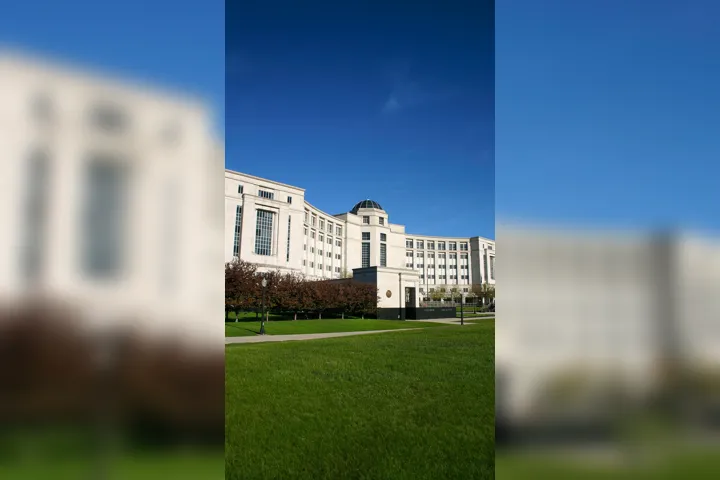
Supreme Court Upholds Birthright Citizenship, Rejecting President Trump's Executive Order

What's Happening?
The Supreme Court has ruled against President Trump's executive order that aimed to deny birthright citizenship to children born in the United States to undocumented immigrants or temporary foreign residents. The court's decision reaffirms the interpretation of the 14th Amendment, which grants citizenship to all persons born in the U.S. The ruling was based on the historical context of the amendment, which was adopted after the Civil War to ensure citizenship for Black people, including former slaves. The decision was made by a divided court, with Chief Justice John Roberts writing for the majority, emphasizing the amendment's promise of citizenship to 'every free-born person in this land.' The ruling maintains the status quo, where children born in the U.S. are citizens, with exceptions only for children of foreign diplomats and occupying forces.
Why It's Important?
This ruling has significant implications for U.S. immigration policy and the interpretation of the 14th Amendment. By upholding birthright citizenship, the Supreme Court has preserved a long-standing principle that affects hundreds of thousands of children born in the U.S. each year. The decision prevents the potential legal and social ramifications of creating a class of stateless individuals born in the country. It also represents a check on executive power, as the court rejected an attempt by the Trump administration to redefine citizenship through an executive order. This decision could influence future debates on immigration and citizenship, reinforcing the constitutional protections for individuals born in the U.S.
What's Next?
Following the Supreme Court's decision, the Trump administration's efforts to limit birthright citizenship have been halted. However, the ruling leaves open the possibility for future legislative action, as Justice Brett Kavanaugh noted that Congress could potentially change the law to restrict birthright citizenship. This could lead to renewed political debates and legislative proposals aimed at altering the current interpretation of the 14th Amendment. Additionally, the decision may prompt further discussions on immigration reform and the balance of power between the executive branch and the judiciary.
AI Generated Content
For the benefit of users - Parts of this article may include content generated using AI tools. Our teams are making active and commercially reasonable efforts to moderate all AI generated content. Our moderation processes are improving however our processes are carried out on a best-effort basis and may not be exhaustive in nature. We encourage our users to consume the content judiciously and rely on their own research for accuracy of facts. We maintain that all AI generated content on our platform is for entertainment purposes only. To know more about how we use AI, you can write to us at
Close AI Generated Content