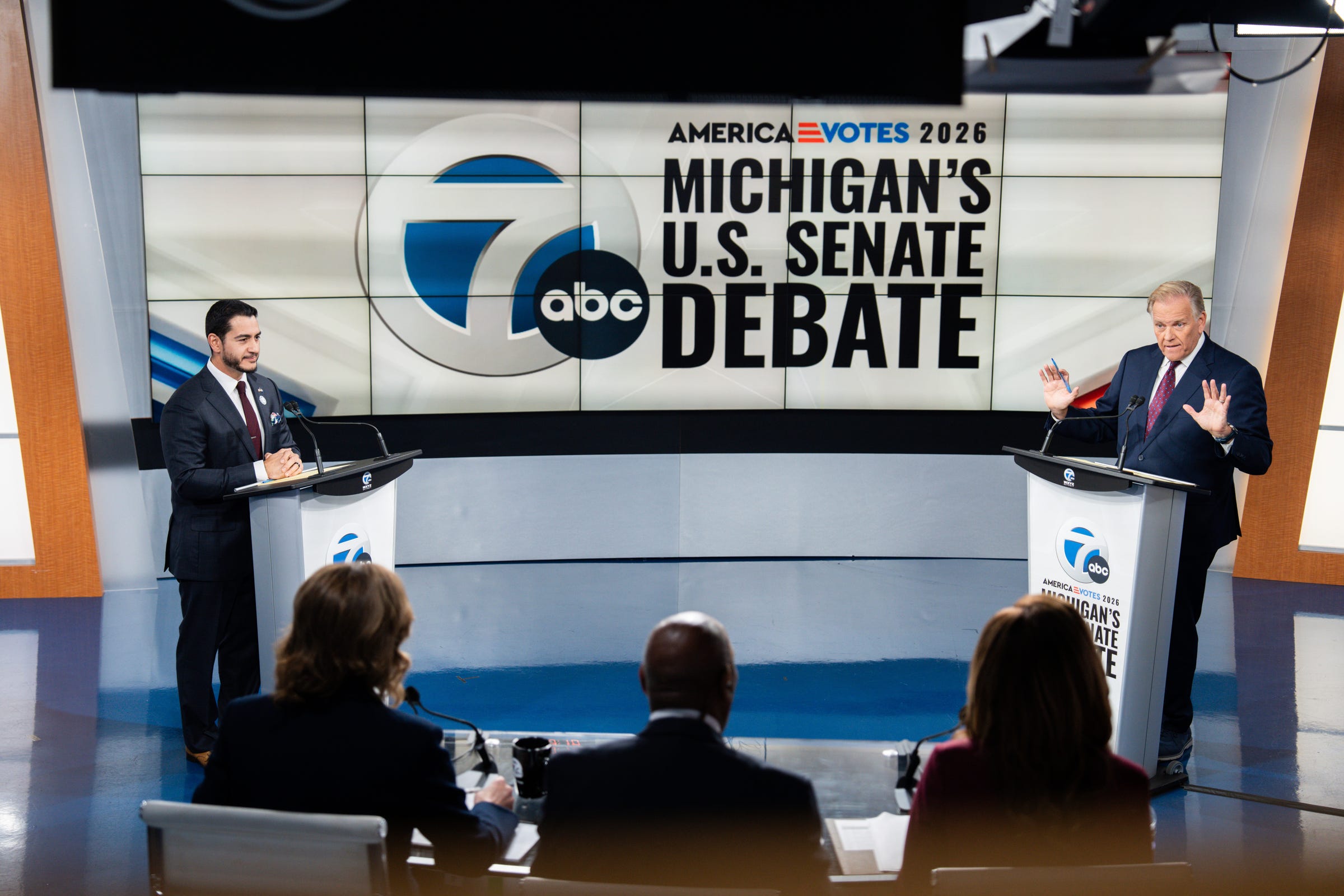
5 takeaways from the final Michigan US Senate debate and what was said

The second and final debate between Abdul El-Sayed and Mike Rogers in the race for Michigan's open U.S. Senate seat on Wednesday, Oct. 21 saw each playing to the hometown crowd in metro Detroit, attempting
to score partisan points, expand their base and frame their opponent as a far different kind of candidate than he and his allies let on.
El-Sayed, Rogers claimed, engaged in "a pattern of deception" over his real aims.
"They are trying to distract you," El-Sayed said of Rogers and the Republican's arguments against him.
And so it went for an hour-long debate at WXYZ-TV's Southfield studios outside Detroit as El-Sayed, the Democratic nominee and former Wayne County and Detroit health director, sparred with Rogers, a former Republican congressman.
Here's a handful of takeaways from this debate ahead of the Nov. 3 midterm election.
More debating, less bickering
There was plenty of back-and-forth arguing and no dearth of personal attacks in this debate, but compared to the one 13 days previous at WOOD-TV in Grand Rapids, it was far more polite.
Yes, there were times when the moderators had to remind one or the other of the time constraints and cut them off. And yes, there were plenty of harangues and invective, true or not.
But it definitely didn't seem as chippy as the scene in west Michigan, as if both were a little more willing to keep from fighting after the bell.
Making a pitch for Detroit and Democrats
It seemed both were acutely aware that this debate was intended for a Detroit audience and the importance of that big voting bloc to their hopes of winning.
Rogers tried to poke holes in El-Sayed's claims of building a statewide political coalition, noting he did not win Detroit in the August primary, a Democratic stronghold. (U.S. Rep. Haley Stevens, D-Birmingham, did, while losing statewide.) Rogers claims he's making inroads in the city. (His wife was recently handing out gas cards at an east side Detroit gas station, according to the Michigan Chronicle.)
But El-Sayed turned the Detroit attack around, saying voters in the city are tired of those questioning the legitimacy of election administration in the city like Rogers has.
El-Sayed said: "Folks in the city of Detroit are sick and tired of watching politicians deny the outcome of elections just like Mike has, just like Donald Trump has." And he dragged Rogers, presumably as a state legislator, as having helped create the emergency manager law that took some authority from Detroiters back in 2013 and remains a sore point in the city.
Rogers also talked up the coalition of Democratic voters he has built to paint his opponent as flailing to secure support from within his own party. And while it's clear some Democratic voters, particularly Jewish voters, are uncomfortable with El-Sayed and his harsh line on aid to Israel, it's far from clear how large that group is (and whether it's not linked to Republican efforts).
Major Democrats have backed El-Sayed, including Gov. Gretchen Whitmer and former President Barack Obama, who is coming into Detroit for him on Saturday, Oct. 24.
DSA vs. Trump
Early and often throughout the debate, Rogers characterized El-Sayed as being aligned with the policies and priorities of the Democratic Socialists of America, or DSA. And repeatedly, El-Sayed tagged Rogers as an ally — referring to him during the debate as a "sock puppet" — of President Donald Trump, a supporter of his policies and having only gotten in the race to replace retiring U.S. Sen. Gary Peters because Trump asked him to do so.
El-Sayed isn't a DSA member, he's made that clear. He does share some policy goals, like enacted universal, government-run health care and cutting military aid to Israel, with that group. But he also says he is a capitalist, one who wants more competition between business, not less.
As for Rogers, he had defended — or at least failed to criticize — Trump's positions on tariffs and on the war in Iran until recently, and is now being accused of flipflopping.
El-Sayed argued several times that Rogers and Republicans were playing "MAGA bingo" with their talking points, which were intended to distract voters from problems like the economy and high inflation.
Rogers said El-Sayed just wanted to connect him with Trump. "This is really about America," he said.
Asked if he plans to attend an upcoming Trump rally on Sunday, Oct. 25, Rogers told reporters: "I don't even know all the details."
"But I'd go," he added.
During the debate El-Sayed claimed that Rogers invited Trump, telling Rogers he is “embarrassed of the fact that you cannot win this race without Donald Trump coming here and stumping for you. That’s why you begged him to come.”
More: Tariffs, AI, health care: El-Sayed and Rogers field questions in Detroit
Take our poll: Who won Abdul El-Sayed and Mike Rogers U.S. Senate debate?
Policy disagreements discussed
Rogers made his recent point on tariffs, especially as they regard Canada, again, saying the trade war with Michigan's neighbor needed to end after having previously defended it.
He also partially defended Trump's tariffs again, arguing it had been good for the auto industry in some cases (while in fact, it's been a decidedly mixed bag with auto parts makers losing jobs over the last year.)
El-Sayed again argued in favor of tariffs, but not in the unilateral and sweeping manner used by Trump.
The two candidates also argued over Social Security, which is expected to be unable to pay its debts as of 2032, with Rogers repeating an unproven Republican claim that rooting out fraud could help stabilize it and El-Sayed arguing that taxing the wealthy could provide enough funding to right its finances, when it would likely take more than that.
Meanwhile, Rogers blasted El-Sayed's push for universal health care, Medicare-for-All, saying it would destroy Medicare as we know it and take away people's health care; as a practical matter, there is no evidence it would do either, though it likely would mean (El-Sayed's claims aside) that people with private or employer-sponsored health care would not have the same plans they do now. (Instead, they would likely fall under the Medicare-for-All plan if implemented.)
Also, during a yes/no answer on whether either supported expanding the U.S. Supreme Court: Rogers said, "no." El-Sayed said "yes, but fairly." Asked for the same yes/no response on whether either supported universal background checks for firearm purchases: El-Sayed said "yes," Rogers said, "It depends."
Terrorist ties vs. warmonger
As expected, Rogers attempted to hammer El-Sayed again as having donors "from Hamas, Hezbollah," with no clear evidence supporting that or that El-Sayed has any link to those or any other groups advocating political violence, as the Free Press has previously reported.
"We need to know, are you for America or these terrorist groups overseas?" Rogers said. "That is a risk to our national security."
El-Sayed, meanwhile, called out Rogers' changing stance on the Iran war and noted Trump's weekend appearance in Michigan, suggesting the two remain in lockstep, despite Rogers' claims of independance.
"They are hip-to-hip on this war, and you are paying the cost," he said.
And Rogers, who has recently called for a swift end to the war, which is driving up fuel prices and driving down Republican chances in the midterm elections, did seem to defend the decision to go to war with Iran.
"You want to pay $8 a gallon in gas? Let Iran get control of that region," Rogers said on the debate stage.
In closing, Rogers continued to paint his Democratic opponent as extreme.
"If you think about what's at stake in this election, it really isn't about left versus right anymore. It really is about the heart and soul of the country and who we are as Americans and the future we want for our children," he said.
El-Sayed ended by describing himself as a patriot concerned that cost-of-living challenges and corporate interests in politics have curtailed opportunity for Americans.
"Nobody appreciates the promise of America like somebody who understands exactly what America gave me," he said. "I love this country. I love the Constitution and what it protects for all of us. But right now, it has gotten way too hard."
Will it make any difference?
Aaron Kall, director of debate at the University of Michigan, didn't think so, believing Rogers had a hard time giving succinct answers in the time allowed and El-Sayed "had an annoying habit of continually referring to his opponent as 'my guy.'"
"Much like their first contest, tonight's debate between Abdul El-Sayed and Mike Rogers was a heated exchange that mostly yielded a draw or split-decision that is likely unlikely to change the minds of many undecided voters," Kall said.
Contact Todd Spangler: tspangler@freepress.com. Follow him on Twitter @tsspangler. Contact Clara Hendrickson at chendrickson@freepress.com or 313-296-5743.