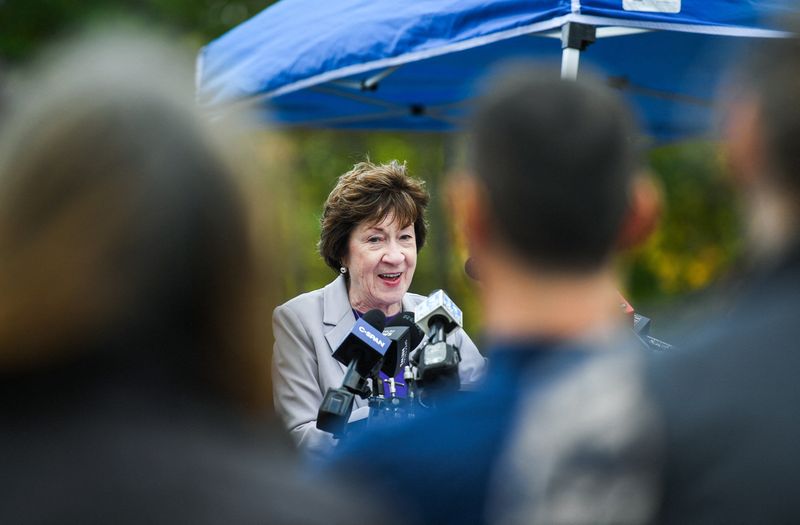
Last Republican incumbent senator in a Democratic-leaning state fights for survival

By Andy Sullivan
WINDHAM, Maine, Oct 27 (Reuters) - If Republican Senator Susan Collins wins this nail-biter of an election, it may well be because voters in Maine decide she is not Republican enough.
her first victory in 1996, Collins’ reputation as an independent-minded moderate has helped her win reelection even as Maine backed Democrats for president. Now the only Republican incumbent running in a Democratic-leaning state, she is deadlocked in opinion polls with Democrat Troy Jackson in a race that could help determine control of the US Senate.
Democrats need a net gain of four seats to take control of the 100-seat Senate from Republicans in the November 3 midterm elections. Jackson, a rough-hewn former logger and state Senate president, has attacked Collins as a rubber stamp for Republican President Donald Trump.
Collins is countering with the clout she has amassed over her 30-year Senate career, highlighting projects she has funded and carve-outs she has secured to lessen the economic fallout from Trump’s spending cuts, tariffs and war with Iran.
“If it wasn't Susan Collins, this race would have been over three months ago,” said Maine Democratic consultant Toby McGrath.
But strategists in both parties say the pool of the independent-minded, persuadable voters who backed Collins in previous elections has shrunk as partisan lines have hardened and Trump has galvanized Democrats in opposition.
“If you hate Trump, you're voting for whoever the Democrats put on the ballot,” said Phil Harriman, a former Republican state senator.
Democrats faced a potential debacle this summer, when Graham Platner, an oyster farmer and Marine veteran, won the party’s nomination only to drop out after facing a rape accusation that he denied.
The party quickly united behind Jackson, who has invoked his hardscrabble upbringing in the remote logging town of Allagash as he campaigns on a populist agenda of universal healthcare and raising taxes on the wealthy.
“I saw at a young age how people with money and power and influence can hold people back,” he said at a campaign event on Saturday.
$1.5 BILLION IN EARMARKS
In recent weeks, Collins has visited projects she has funded through her work on the powerful Senate Appropriations Committee: a wastewater treatment plant in North Windham, a dock in Bucksport, an emergency center in Farmington. She says she has secured nearly $1.5 billion in earmarks since 2021.
“This has required hard work, knowledge and seniority. The question for voters in this campaign is who can do more for Maine,” she said at an October 15 debate.
That influence, she argues, has also helped to shield Maine from the Trump administration’s policies.
As Trump’s trade war with Canada has hammered the state’s economy, Collins has pointed to tariff exemptions the administration has granted at her request for road salt, cement and equipment used by the state’s blueberry, potato and apple growers.
The Trump administration also credited her when it released home-heating oil reserves to try to drive down prices that have increased more than 70% since last year – a crucial issue in a state where roughly half of households rely on the product.
Collins has also pointed to a $50 billion fund she crafted to help rural hospitals cope with healthcare cuts in the 2025 tax and spending package that enacted most of Trump’s legislative agenda, as well as money for body-worn cameras and de-escalation training for federal immigration agents following the January killing of two US citizens in Minnesota.
'THERE SHOULDN'T BE A LIST'
Jackson argues that these carve-outs amount to little when weighed against the damage caused by Trump.
Body cameras and de-escalation training did not stop an immigration agent from killing a state resident in July, he says, and residents would not be struggling to heat their homes if Trump had not started the war with Iran, which has pushed up oil prices globally.
Trump’s trade war with Canada, he argues, is only possible because Republicans in Congress have surrendered their authority over tariffs to Trump.
“I can't believe that the most powerful US senator in the world would stand there and say, 'Well, I got this and this and that off the list,' instead of the fact that there shouldn’t be a list,” he said on Saturday.
SIX ADS IN A ROW
Meanwhile, a relentless ad war has played out over the state’s airwaves. AdImpact, an analysis firm, estimates $199 million will be spent on the race – equal to $170 for every adult in the state.
During a local newscast on Friday, six ads in a row were devoted to the contest.
Those ads are chasing a small slice of undecided voters.
Democratic activists say they are encountering relatively few people who have yet to decide on a candidate as they campaign door-to-door in Windham, a Portland suburb that backed Collins by a 14-point margin in 2020, even as it backed Democrat Joe Biden over Trump for president.
“There’s just a lot less of that persuadable middle than we historically see,” said volunteer Austin Coco.
Windham resident Jim Tabor, a retired optician, said he has grown disillusioned with the Republican Party under Trump. A Collins supporter in past elections, he said this year he will back Jackson.
“If he turns out to be a bum, I’ll vote against him next time. But Susan Collins won’t be there,” he said.
(Reporting by Andy Sullivan; Editing by Michael Learmonth and Howard Goller)