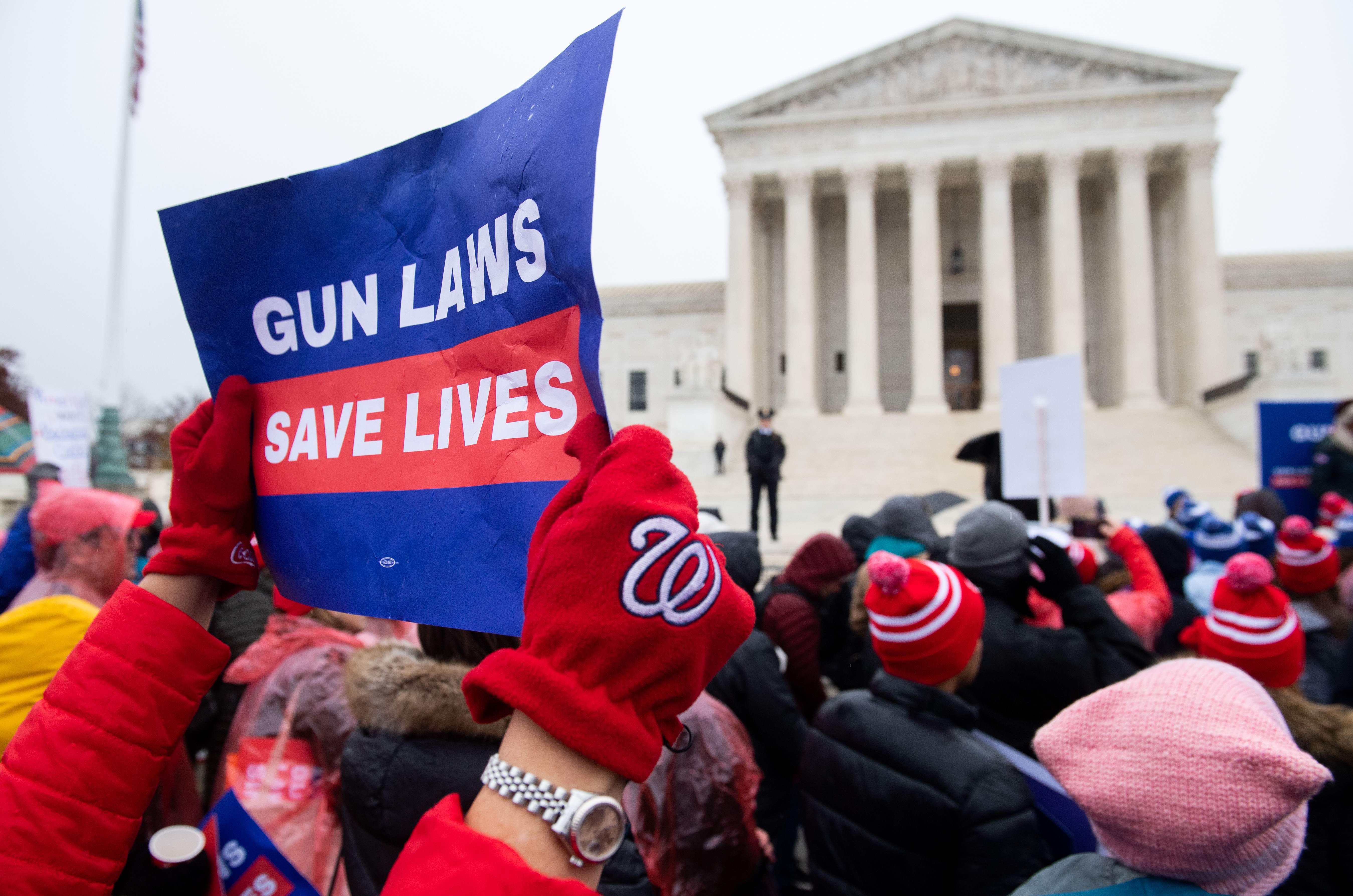
Supreme Court won't weigh in on gun bans in `sensitive' places

WASHINGTON – The Supreme Court won't decide how far states may go to ban guns in "sensitive" places − such as government buildings, public transportation, hospitals, stadiums and parks − dodging another
gun rights dispute in the court's ongoing debate over the reach of the Second Amendment.
The court on Nov. 16 declined to hear a challenge to Maryland’s rules about where guns are prohibited.
The justices are already scheduled to debatein December whether bans on assault-style weapons are constitutional.
More: What the Supreme Court's test for gun rules could mean for AR-15s this year
The justices have been inundated by gun rights appeals as the court refines how to apply a landmark 2022 ruling, which said firearm regulations must be “consistent with this nation’s historical tradition of firearm regulation.”
That 6-3 decision in New York State Rifle & Pistol Association v. Bruenalso significantly expanded the Second Amendment right to bear arms outside the home.
But some Democrat-led states latched onto the court’s comments that firearms may still be banned in “sensitive places,” a category the justices did not define.
The gun owners and advocacy groups challenging Maryland’s rules argue the state’s definition is too broad.
“The Supreme Court has been clear that the Second Amendment protects a right for individuals to carry for self-defense as they go about their daily lives,” Adam Kraut, executive director of the Second Amendment Foundation, said in a statement. “Put bluntly, when forced by the Supreme Court to issue carry permits, Maryland simply made those permits useless everywhere.”
An appeals court based in Virginia rejected the group’s challenge. Similar gun-control measures in other states have been upheld by other appeals courts, although not always for the same reasons or for the same types of locations.
In asking the Supreme Court to get involved, gun rights groups called the various lower court rulings “an incoherent morass.”
Maryland said the advocacy groups’ definition of a sensitive place is too restrictive and would only allow guns to be banned from facilities protected by armed government security such as a federal courthouse.