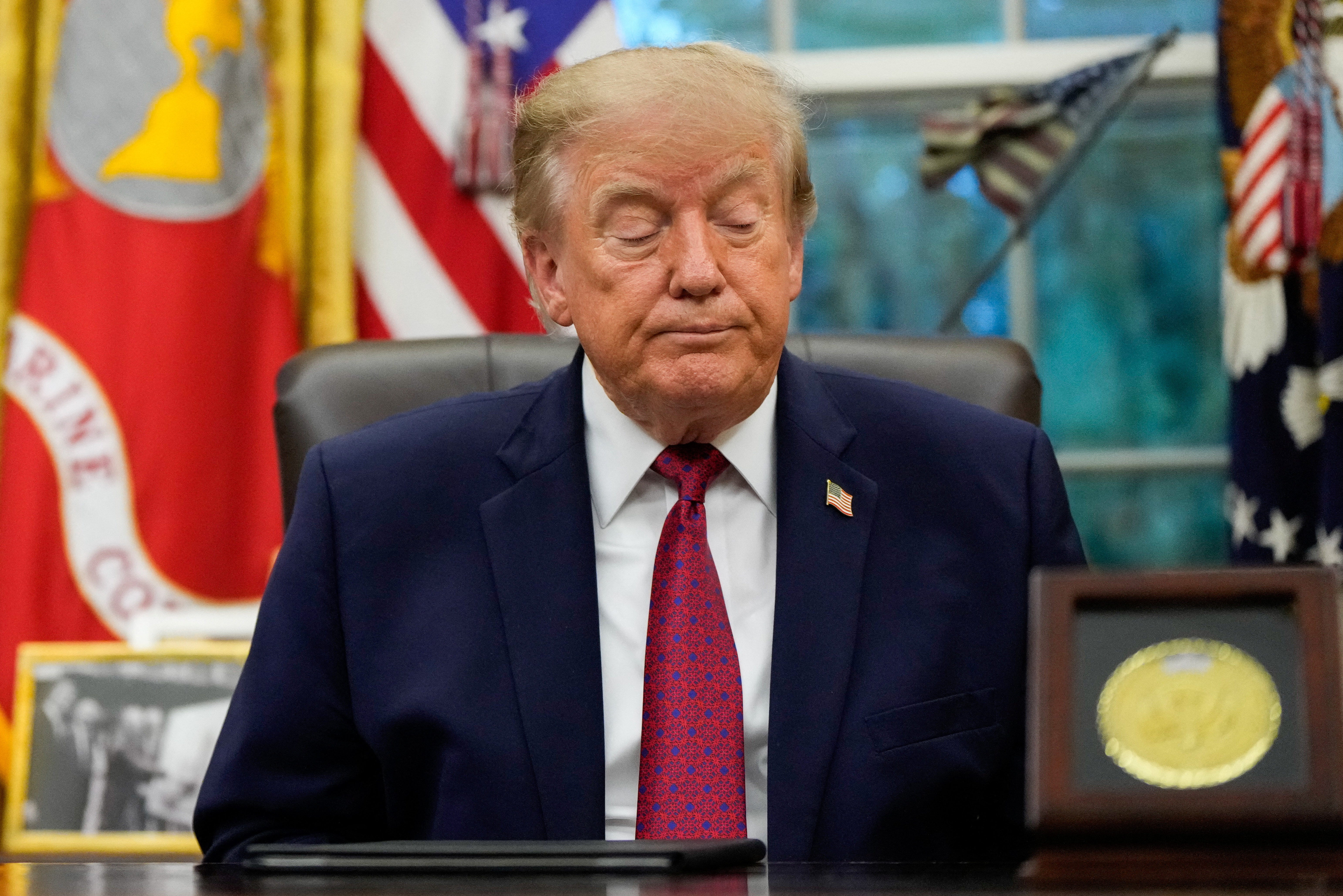
Graham, Paxton and Ramaswamy lost. Some blame Trump for choosing them

Almost immediately after the Democratic tsunami toppled the Republican majorities in Congress, some right-leaning commentators began blaming President Donald Trump for pushing flawed candidates onto the November
Several candidates anointed by the president in Republican primaries lost in the general election, including Senate candidates in states he'd won by double digits such as Texas and South Carolina. Those same states haven't been represented by a Democrat in the Senate in decades.
"If you run clowns, you will get clown show in the end and this is what has happened here," Buck Sexton, a conservative talk radio host, said during a Nov. 3 episode of "Louder with Crowder", a controversial MAGA-coded YouTube program. "And Trump had a hand in this, too, big time."
Republican National Committee Chairman Joe Gruters told USA TODAY shortly before the election that Trump was "choosing winners."
But after ignoring warnings from Republican leaders in key states that some of his choices were too polarizing or inexperienced, the president's endorsement scorecard took a considerable hit this fall.
During this year's GOP primary contests, 96% of the candidates he backed across congressional, state legislative and statewide elections won, according to Ballotpedia, a digital encyclopedia of U.S. politics and elections.
When it came to the general election, however, Trump's effectiveness dropped to 67% overall. He had a 89% success rate two years ago and a 79% win level in 2020.
Zachary Albert, a political science professor at Brandeis University in Massachusetts, said the overall bleak environment for Republicans is the main reason the party lost in swing states like Georgia and Michigan, and in battleground districts, where he said even better quality Republicans would have likely lost.
But he said Trump's decision to back loyalists will "haunt" Republicans in places they should have easily carried, such as South Carolina, where the president favored political novice Darline Graham over more experienced candidates.
"In general elections, especially in a year in which people are angsty about the economy, the war and corruption these candidates who have been selected and vetted for loyalty to Trump, that is not the standard that general election voters are using to decide," Albert said. "In fact, it can cut against them."
Conservative groups aligned with the administration say candidate quality definitely played a part in the 2026 midterm losses. But that repudiation by voters, which many argue was largely over the war with Iran and higher gas prices, gives Republicans a chance to reset ahead of the upcoming presidential election.
"Obviously, it's no fun to be in the minority, but what it does give you is an opportunity for reflection and the chance to really think about what's going to make things work," Doug Blair, a spokesman for Heritage Action, the lobbying arm for the conservative-leaning Heritage Foundation, told USA TODAY in an interview.
"Trump's endorsement was quite powerful in the past, and I think that there is going to obviously be a reckoning over whether or not that's going to be the the best way forward," he added. "What we are are welcoming in is the idea that we are going to have a much more robust conversation about who is going to be part of the coalition and who is going to represent us going into elections."
President's picks mostly fall short in battlegrounds
Just half of the 26 candidates that Trump endorsed for the U.S. Senate won where their races despite all but two of those contests taking place in states the president had won in 2024.
Chief among them is Texas Attorney General Ken Paxton, a scandal-plagued Republican nominee who lost to Democratic state Rep. James Talarico by 12 percentage points in a state Trump won by almost the same margin two years ago.
Trump ignored pleas from top Senate leaders and campaign advisers to go with incumbent Sen. John Cornyn, who had safely won re-election by double-digit margins previously.
"(Paxton) ran the worst campaign I’ve ever seen anybody run," Glenn Beck, a conservative political commentator, said during a Nov. 3 episode of the PBD Podcast, hosted by Patrick Bet-David, another conservative media personality. "He ran the worst campaign I’ve ever seen anybody run. It’s like he wasn’t even running and he just wasn't trustworthy to too many people here in Texas."
Things didn't get much better for Trump's touch outside of the Senate contests, where a total of 46 Trump-backed House candidates have lost their races with more still pending, according to Ballotpedia. Among those who fell were Rep. Max Miller, of Ohio, a former White House aide accused of abusing his 2-year-old daughter and ex-wife, the daughter of Sen. Bernie Moreno, a fellow Republican.
Miller denied the accusations, but that controversy engulfed Ohio's 7th Congressional District, which Trump won by 11 percentage points in 2024. He lost to Democrat Brian Poindexter, a union ironworker, by 9 percentage points.
But other questionable picks, such as Anthony Constantino, an upstate New York sticker company CEO and former boxer who Trump backed over the state GOP's suggestions, survived. Constantino defeated his Democratic opponent by about 2 percentage points.
The president's grade also dropped further when looking at races for governor where he backed 23 candidates overall, including Ohio Republican Vivek Ramaswamy, who lost by 8 percentage points to Democrat Amy Acton after his campaign ran a controversial ad featuring her estranged mother. Trump encouraged Ramaswamy to stand by the ad, which was roundly condemned by Republican Gov. Mike DeWine and other GOP leaders.
Just nine of Trump's gubernatorial picks won their statewide elections. About 75% of Americans now live in states that will have Democratic governors.
The White House did not respond to USA TODAY's request for comment when asked if the president regretted backing some or any of these candidates against GOP leaders advice.
'Better soldiers': MAGA faithful losing trust in Trump?
Several MAGA figures are openly questioning if continued faith in Trump is the best course for Republicans going forward after Democrats flipped more than 40 House seats, seven Senate seats, five governor's mansions and as many as a dozen state legislative chambers.
Former Disney star Caroline Sunshine, who worked in the first Trump administration, said the midterm results showed many in the populist-fueled movement base still like the president but, "we just don't like the direction that you're taking us in."
She said rather than dumping the president, the White House should shuffle its staff.
"So we just need better soldiers," Sunshine said during a Nov. 4 interview with Fox News. "We just need a fresh batch of soldiers to come in and take up the baton and keep going."
In the aftermath of losing Congress, the president has mostly ignored publicly reckoning with the nation's rebuke. But the administration began responding with a dramatic shake-up Nov. 6, naming top aide Stephen Miller, an immigration opponent, to replace Susie Wiles as White House chief of staff.
John Feehery, a Republican consultant and former top congressional aide, told USA TODAY that Trump made this year's midterms a referendum on himself. He said those losses will give conservatives on Capitol Hill more freedom to work with Democrats on certain bipartisan measures and tiptoe away from the White House.
"They can now kind of start distancing themselves and charting their own course," Feehery said. "Trump has dominated the party since 2016 and now the party can move on. They don't have to be loyal to Trump anymore, they just have to be loyal to their voters."
The president's endorsement "still packs a punch" in GOP primaries but that it will be judged more on a case-by-case basis going foward, he said.
Exit polls showed 15% of non-MAGA Republicans walking away from Trump and flocking toward the Democratic side. That split could widen further as potential successors to the GOP mantle, such as Vice President JD Vance, Texas Sen. Ted Cruz and Florida Gov. Ron DeSantis appear to be jockeying for the 2028 nomination.
Republican Spencer Deery, an Indiana state legislator, defied the president's demand for mid-decade redistricting last year. He was one of two incumbents who survived reelection out of the seven incumbents targeted by a Trump-backed primary challenger earlier this year, winning by a mere three votes in a district that saw an unprecedented $2 million in dark money spending.
"It may be the single greatest political accomplishment that I may ever have because it's quite a force that comes after you," Deery said.
Deery, who once worked as a public policy research aid at the U.S. Department of Veterans Affairs, said the loyalty tests and primary threats by the administration have undercut candidate quality across the country. He said it ultimately hurts the GOP's flexibility to protect their majorities or rebuild coalitions.
Of the five Indiana Republican challengers who were backed by the White House in May, two lost their state Senate bids. Indiana Democrats flipped five state Senate seats overall.
"I think certainly that (Trump) endorsement has never meant less than it does now," Deery told USA TODAY.