NASA's Artemis II Mission Relies on Advanced Communication Networks

What's Happening?
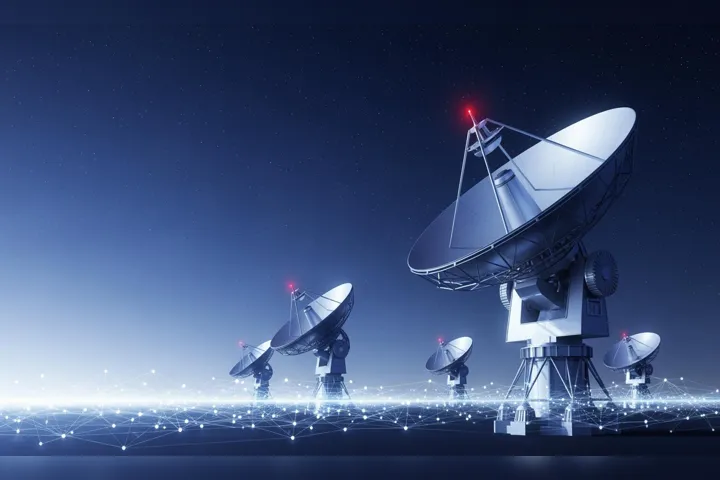
NASA's Artemis II mission, which will transport four astronauts around the Moon, is heavily reliant on advanced communication networks to ensure mission success. The mission will utilize NASA's Near Space Network and Deep Space Network to maintain communication between the spacecraft and mission controllers on Earth. These networks, managed by NASA's SCaN Program, use global infrastructure and relay satellites to provide seamless communication and tracking. The mission will also feature the Orion Artemis II Optical Communications System, a laser communications terminal that can transmit data over laser links, offering significantly higher data rates than traditional radio networks.
Why It's Important?
Reliable communication is crucial for the safety and success of human spaceflight missions. The Artemis II mission's reliance on advanced communication networks underscores the importance of robust infrastructure in supporting deep space exploration. These networks enable real-time communication, data transmission, and navigation, which are essential for mission planning and execution. The development and deployment of laser communication systems represent a significant technological advancement, potentially transforming how data is transmitted in space. This capability is vital for future missions to the Moon and Mars, where high-bandwidth communication will be necessary.
What's Next?
NASA is working on further enhancing its communication capabilities for future Artemis missions. The agency plans to deploy a network of relay satellites around the Moon to eliminate communication blackouts and support precise navigation. This initiative, part of NASA's Lunar Communications Relay and Navigation Systems project, aims to provide continuous, high-bandwidth communication services for lunar missions. The success of these efforts will be critical for the Artemis program's long-term goals, including establishing a sustainable human presence on the Moon and preparing for missions to Mars.
AI Generated Content
For the benefit of users - Parts of this article may include content generated using AI tools. Our teams are making active and commercially reasonable efforts to moderate all AI generated content. Our moderation processes are improving however our processes are carried out on a best-effort basis and may not be exhaustive in nature. We encourage our users to consume the content judiciously and rely on their own research for accuracy of facts. We maintain that all AI generated content on our platform is for entertainment purposes only. To know more about how we use AI, you can write to us at
Close AI Generated Content