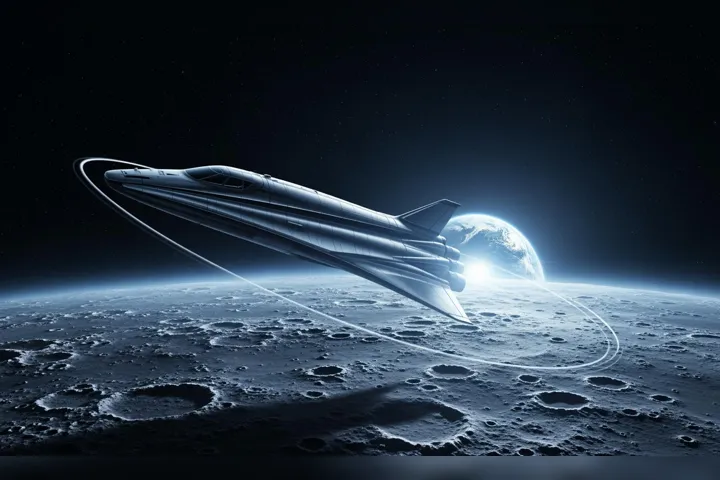
Artemis II Crew Enters Lunar Space, Prepares for Historic Moon Flyby

What's Happening?
NASA's Artemis II mission has reached a critical phase as the Orion spacecraft and its four-person crew enter the Moon's sphere of influence. This marks the first time humans have crossed the lunar threshold since the Apollo 17 mission in 1972. The crew, consisting of Reid Wiseman, Christina Koch, Victor Glover, and Canadian Jeremy Hansen, is set to perform a flyby of the Moon's far side, taking humans deeper into space than ever before. The mission aims to break the distance record for human spaceflight, surpassing the Apollo 13 record by over 4,000 miles. The crew will also witness a solar eclipse from space, providing unique scientific observations.
Why It's Important?
The Artemis II mission is a pivotal step in NASA's efforts to return humans to the Moon and establish a sustainable presence. By successfully navigating the lunar sphere of influence and conducting a flyby of the Moon's far side, the mission demonstrates the capabilities of the Orion spacecraft and the readiness of the crew for future lunar landings. The mission's scientific objectives, including observations of the Moon's surface and a solar eclipse, will contribute to our understanding of lunar geology and the solar system. The mission also underscores the importance of human presence in space exploration, as astronauts can make observations and discoveries that are beyond the capabilities of robotic missions.
What's Next?
Following the Artemis II mission, NASA plans to continue its Artemis program with the goal of landing astronauts on the Moon by 2028. The data and experience gained from Artemis II will inform the planning and execution of future missions, including Artemis III, which aims to land astronauts near the Moon's south pole. This region is of particular interest due to the potential presence of water ice, which could support long-term human habitation and serve as a resource for future missions. The success of Artemis II will also bolster international partnerships and inspire further investment in space exploration technologies.
AI Generated Content
For the benefit of users - Parts of this article may include content generated using AI tools. Our teams are making active and commercially reasonable efforts to moderate all AI generated content. Our moderation processes are improving however our processes are carried out on a best-effort basis and may not be exhaustive in nature. We encourage our users to consume the content judiciously and rely on their own research for accuracy of facts. We maintain that all AI generated content on our platform is for entertainment purposes only. To know more about how we use AI, you can write to us at
Close AI Generated Content