New Study Reveals Ammonites Survived Asteroid Impact Longer Than Previously Thought

What's Happening?
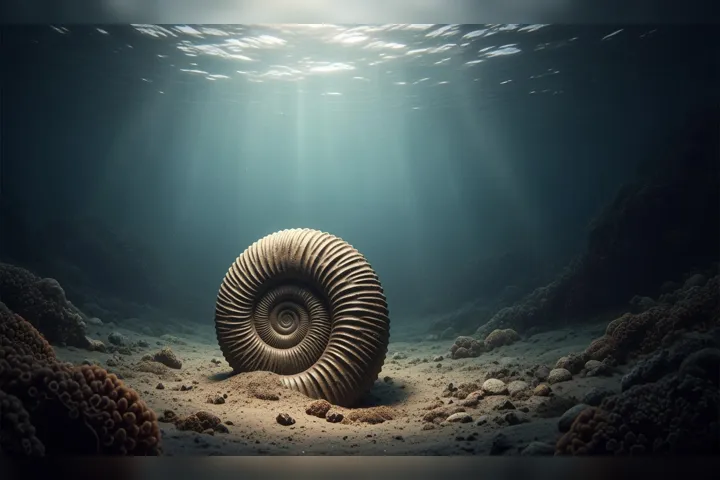
A recent study published in Scientific Reports has challenged the long-held belief that ammonites, spiral-shelled marine creatures, were wiped out alongside the dinosaurs 66 million years ago. The research, conducted by Professor Marcin Machalski and his team from the Polish Academy of Sciences, discovered ammonite fossils in Denmark's Stevns Klint, dating from the early Paleogene period, tens of thousands of years after the asteroid impact. These findings suggest that ammonites survived for up to 200,000 years post-impact, contradicting the theory that they perished immediately due to rapid ocean acidification and food chain collapse. The study highlights the presence of three ammonite genera: Hoploscaphites, Baculites, and Fresvillia, with the latter being previously unseen in the region during the late Cretaceous.
Why It's Important?
This discovery is significant as it revises the scientific understanding of extinction events and the resilience of marine life. The findings suggest that ammonites, despite surviving the initial asteroid impact, eventually succumbed to long-term environmental stresses, a phenomenon known as 'Dead Clade Walking.' This challenges the completeness of the fossil record and emphasizes the need for careful analysis and interpretation of paleontological data. The study also underscores the potential for new evidence to reshape widely accepted scientific timelines, offering insights into the evolutionary processes that have shaped marine ecosystems.
What's Next?
The study opens avenues for further research into the survival mechanisms of ammonites and other marine species post-extinction events. Scientists may focus on exploring other well-preserved geological sites to uncover additional evidence of post-impact survival. This could lead to a better understanding of how certain species adapt to catastrophic environmental changes and the factors contributing to their eventual extinction. Additionally, the findings may prompt a reevaluation of other extinction events and the resilience of life forms during such periods.
AI Generated Content
For the benefit of users - Parts of this article may include content generated using AI tools. Our teams are making active and commercially reasonable efforts to moderate all AI generated content. Our moderation processes are improving however our processes are carried out on a best-effort basis and may not be exhaustive in nature. We encourage our users to consume the content judiciously and rely on their own research for accuracy of facts. We maintain that all AI generated content on our platform is for entertainment purposes only. To know more about how we use AI, you can write to us at
Close AI Generated Content