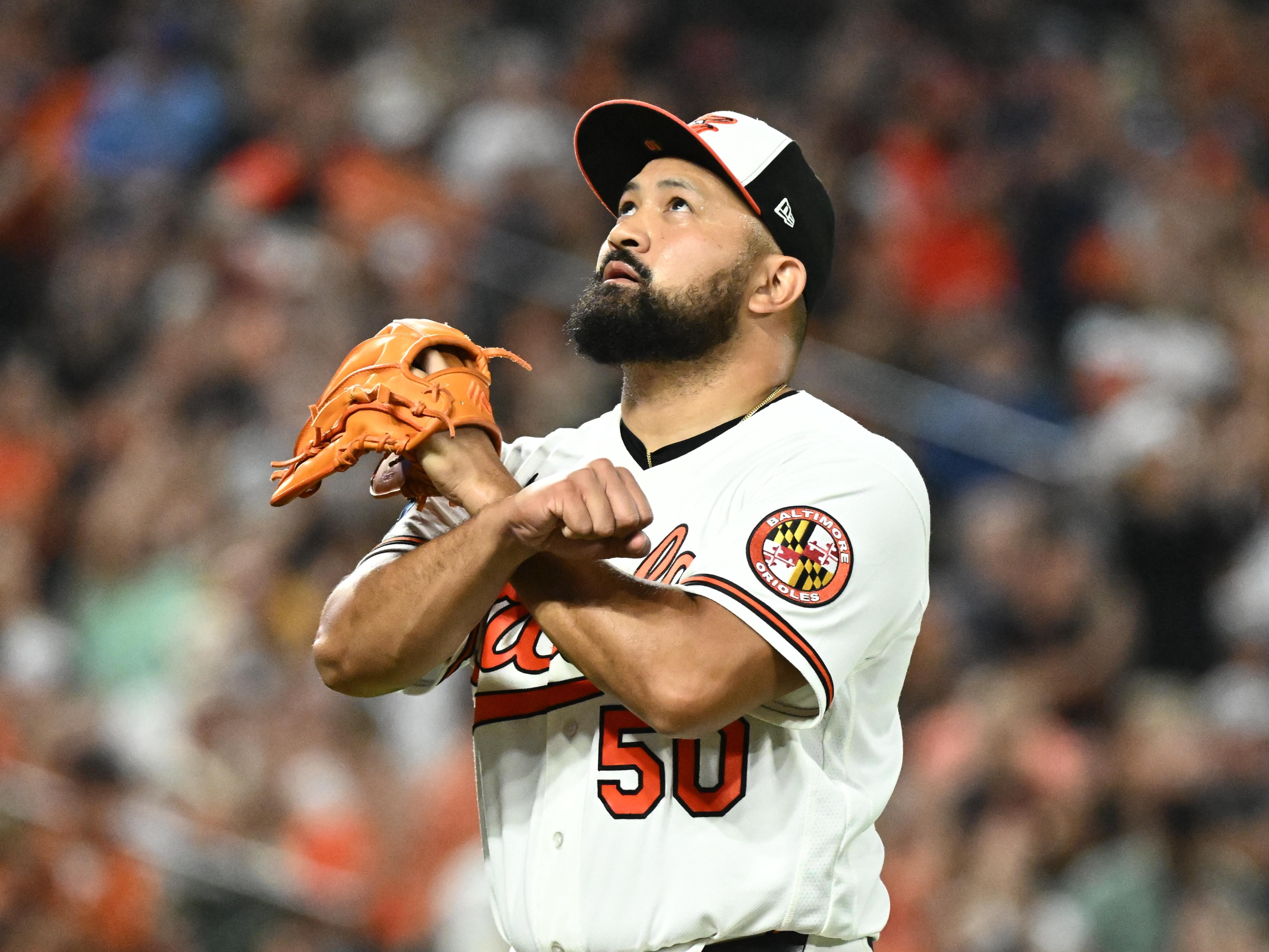
Rico Garcia had a season with more highs than lows

Aug 22, 2026; Baltimore, Maryland, USA; Baltimore Orioles pitcher Rico Garcia (50) reacts during the tenth inning against the Tampa Bay Rays at Oriole Park at Camden Yards. Mandatory Credit: James A. Pittman-Imagn Images | IMAGN IMAGES via Reuters Connect
Rico Garcia is everything that’s right with baseball. At 5-foot-9, he certainly doesn’t have the physical appearance of a hard-throwing, major league reliever. And coming into this season, the back of his baseball card
looked more like a guy hanging onto the fringes of a 40-man roster for dear life than someone leading one of the league’s better bullpens. But now, coming off of a career-best campaign at age 32, he might be headed for the first offseason of his professional life where he can feel pretty confident that he is making the Opening Day roster at the other end of it.
Coming into 2026, Garcia had appeared in 59 total major league games, spread across five seasons and seven different franchises. That included two stops in Baltimore. The first came back in 2022, when he pitched in six games for the big league squad, but spent most of the season down on the farm. He would be released after that season and then bounce around the league again until landing back with the O’s near the end of the 2025 campaign.
Garcia’s showing in 2025 with the Orioles laid the groundwork for the success to come for him in 2026. Over 20 total appearances last season he had a 2.84 ERA while striking out 20 over 19 innings. Some of the peripherals weren’t great. For example, he also had 1.421 WHIP and 4.03 FIP while leaving an unsustainable 92.1% of runners on base. But it was enough to give him an edge in the bullpen competition that played out back in the spring.
The diminutive righty was dominant down in the Grapefruit League. He worked 5.2 innings in which he never gave up a hit, walked just one, and struck out seven. He made the Opening Day squad with ease, and would end being the most dependable member of the group.
Garcia’s 75 appearances and 67 innings led all Orioles relievers, as did his 19 holds and 68 strikeouts. He also ranked second on the team in saves (10), behind only Andrew Kittredge (11), and ahead of Ryan Helseley (8).
This time around, the secondary numbers largely supported the top line metrics. His 3.09 ERA was slightly worse than his 2.92 xERA, though still quite a bit better than his 3.89 FIP/3.77 xFIP. He left a more reasonable 75.4% of runners on base. And he had a decent strikeout (9.13 K/9) and walk (2.96 BB/9) numbers.
These “good, not great” numbers feel like a fair reflection of a season that saw Garcia oscillate between elite reliever early on, to walking disaster midway through the year, before finally settling late as a nice, solid bullpen option.
His month-by-month ERAs paint a clear picture: 0.66, 0.77, 6.97, 4.91, 3.75, and 2.16. Home runs were an issue for him in June and July. He gave up nine long balls all season, eight of them came in that two-month span. Those were worrying times for Garcia, as home runs had sunk him before in his career, and it was entirely possible that a reliever, the most fickle of all MLB players, could be spiraling out of usefulness.
Instead, Garcia got back to work. He didn’t allow a home run over his final 25 appearances, and gave up a run of any kind in only three of those games. His ERA didn’t move much due to one implosion on August 10, where he allowed four runs without recording an out, but his FIP dove from 4.47 on July 29 to 3.85 at season’s end.
Garcia’s pitch mix was tweaked quite a bit as the season wore on. Early in the year, he led with his four-seamer (38.5% of all pitches in March/April), followed with the slider (24.7%), then the change up (21.8%), and finally his curveball (14.9%). But in September he had almost flipped that on its head. His curveball (40%) became his most-used pitch, followed by the change (32%), then the fastball (22.4%), and at the very bottom was his slider (5.6%).
That change in approach did come with fewer strikeouts. His K rate dropped from 32.6% in the season’s first month down to 24.2% in September. But he actually got more chases and more swing and miss than before. Exit velocities also dipped from their June high of 89.8 mph down to 80.3 in August, before jumping back up in September.
It’s not easy for any major leaguer to make such dramatic in-season adjustments and see success, let alone a 32-year-old that had finally found some big league footing after a decade of clawing his way up the professional ranks. The fact that Garcia was able to make tweaks is a positive reflection of his work ethic and determination, as well as the organization’s ability to make the most out of relief arms they get their hands on.
As a group, the Orioles bullpen was pretty good in 2026. They finished with 5.8 fWAR overall, which was sixth in MLB, and that is while throwing the fourth-fewest innings of any bullpen in baseball, so this was not an accumulation thing. The group limited walks and home runs, and the organization was willing to cycle arms in and out as needed.
The unit goes into this offseason in pretty good shape. Félix Bautista got back at the very end of the season, and is expected back in the mix following what will hopefully be a healthy winter. Helsley has a player option for ‘27 that he is probably going to pick up following an injury-plagued campaign. If he is 100% come spring, that gives the O’s two proven, but physically questionable, vets for the late innings. Yennier Cano had a nice bounce-back year and signed an extension midseason. He should be back. And optionable and projectable arms in Anthony Nunez, Alex Hoppe, and Grant Wolfram give the unit some flexibility.
Garcia is a late-bloomer at 32 years old. He won’t be arbitration eligible until next offseason, and is not set for free agency until after the 2030 season. He has no options, but that should not be be a problem given the makeup of the relief corps laid out above. Unless the Orioles get blown away with a trade offer, they have no incentive to move Garcia after a rock solid campaign. He has shown an ability to get big outs, close games, and make adjustments. That’s an arm you want in your bullpen moving forward.