Malibu sinkhole grows as rain, high surf threaten Southern California

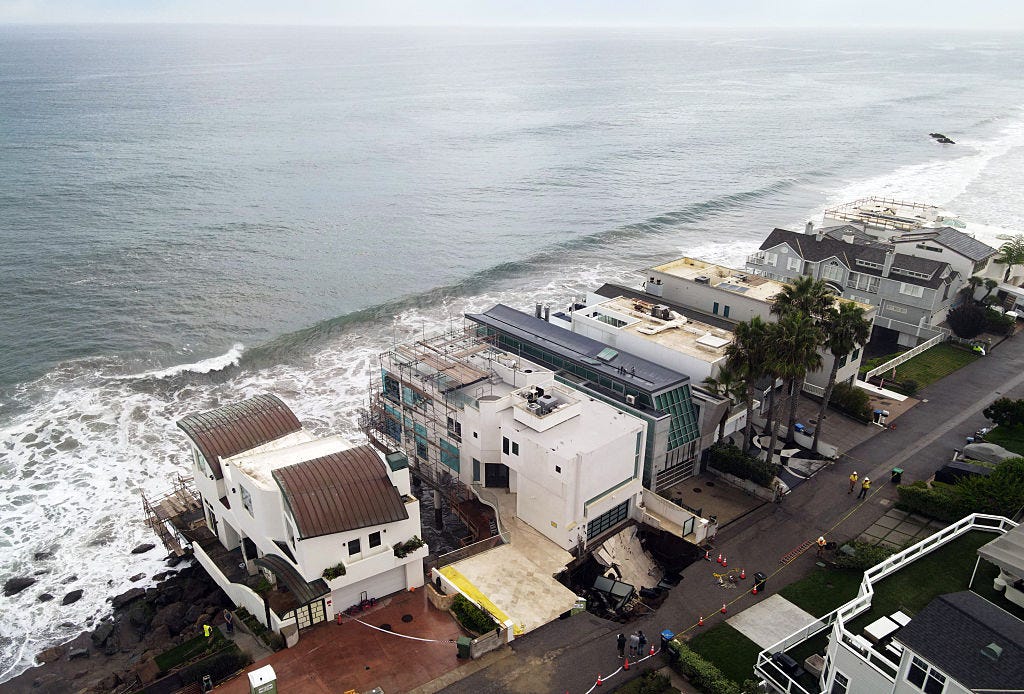
A massive sinkhole that opened near a Malibu home reportedly owned by actor Nicolas Cage has prompted evacuations, as officials warn that rain, high surf, and coastal erosion could worsen conditions.
sinkhole emerged Tuesday, Sept. 8, near a beachfront property on Sea Level Drive. By Tuesday evening, it had grown to roughly 25 to 30 feet deep and measured about 30 feet by 60 feet, according to the city of Malibu.
The driveway next to the home's garage collapsed, and the incident also caused a gas leak. It remained unclear Wednesday, Sept. 9, whether the home itself sustained structural damage.
The city declared a local emergency and ordered evacuations for properties along Sea Level Drive after the expanding sinkhole restricted access for residents and emergency crews.
Property records cited by news outlets show that Cage reportedly owns the property and purchased the Malibu home in 2024. NBC News said the home was unoccupied.
USA TODAY has reached out to Cage's representative, the city of Malibu, and the Los Angeles County Fire Department for comment.
How did the sinkhole form in Malibu?
Officials have pointed to coastal erosion as a major factor behind the collapse. According to SF Gate, some Malibu beaches lost about 3.6 feet of coastline per year.
The sinkhole formed along a beachfront road as powerful surf and high tides battered the Southern California coastline. The city said it is monitoring coastal erosion in several parts of Malibu as strong waves and tides affect the shoreline.
The collapse also follows Southern California's exposure to the remnants of Hurricane Marie over Labor Day weekend.
Marie brought rain and dangerous surf to the region, although the storm did not make landfall in Southern California. The National Weather Service said swells generated by Marie would continue affecting parts of Southern California for several days.
Malibu officials warned that conditions around the sinkhole could worsen with additional rain and high tides.
More: San Andreas Fault stress hits 1,000-year high in Southern California
Can earthquakes contribute to sinkholes?
Southern California is no stranger to earthquakes, with more than 300 faults in the region capable of producing magnitude 6 or larger earthquakes, according to the U.S. Geological Survey.
Earthquakes can contribute to sinkhole formation in some circumstances, particularly when shaking destabilizes already weakened soil or rock, damages underground infrastructure, or causes existing underground cavities to collapse.
However, there is no indication that an earthquake caused the Malibu sinkhole. The city's emergency proclamation instead points to coastal erosion, rainfall, and high surf as factors that could worsen the collapse.
Earthquakes can contribute when they occur in areas already susceptible to ground collapse, but more information about the geology beneath the Malibu property would be needed to determine whether seismic activity played any role in this case.
More: California has moved half a football field, thanks to earthquakes
Strong El Niño could bring more rain to Southern California
The sinkhole is emerging as Southern California prepares for a potentially wetter and stormier season.
A strong El Niño is developing in the Pacific Ocean, a climate pattern that can influence the track and strength of storms reaching the West Coast.
Malibu officials said the expected conditions could bring more strong storms, heavy rain, mudslides, strong waves and coastal erosion along Southern California's coast.
That does not mean every storm will produce flooding or sinkholes, but repeated periods of heavy rain and high surf can place additional stress on vulnerable coastal areas.
Stay informed. Get weather alerts via text
Brandi D. Addison covers weather across the nation as the Weather Connect reporter for the USA TODAY Network and contributes to Texas Connect coverage across the state. She can be reached at baddison@usatodayco.com. Follow her on Facebook here.