US urges NATO allies to prepare in case Russia attacks

BRUSSELS – Russian President Vladimir Putin may not be planning an imminent assault on NATO nations, but the United States says its military allies need to train and invest like he is, so they’re ready
to fend off a sudden attack.
After leaked U.S. intelligence reportedly revealed that Russia could launch a limited assault, such as a land incursion or cyberattack, on a member country within the next few years, America’s allies have been on high alert.
The warning contradicted assessments that Putin would not attempt to draw NATO into a fight while he’s battling Ukraine – and came amid concerns about a U.S. weapons shortage, as the Trump administration wages war on Iran.
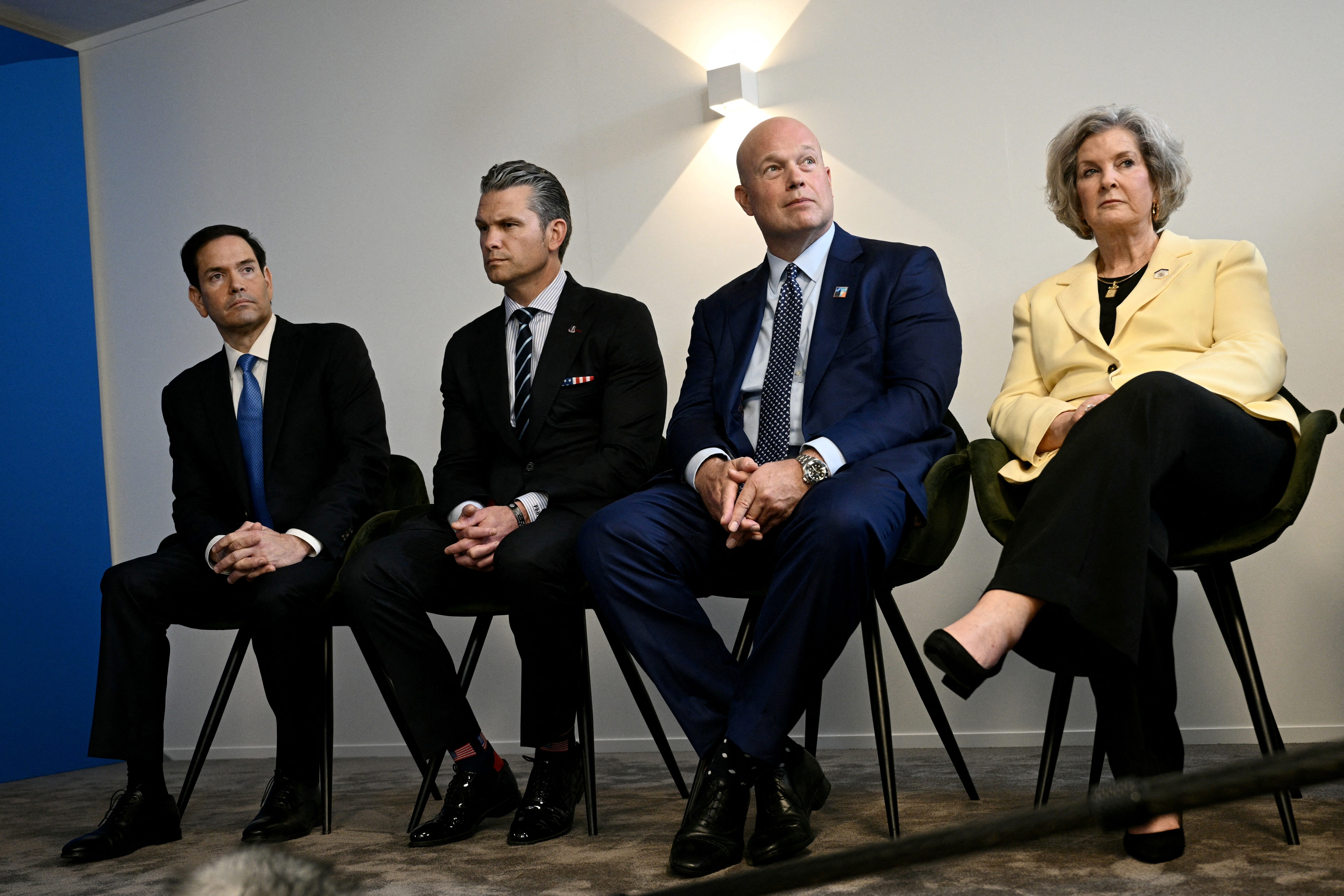
In an exclusive interview with USA TODAY at the military alliance’s headquarters in Brussels, U.S. Ambassador to NATO Matt Whitaker declined to comment directly on the leaked intelligence, while stressing a need for allies to be vigilant in their defense spending and weapons production.
“You can't predict what Vladimir Putin's going to do or any adversary. All you can do is be prepared for it and deter and make it not worth their time to make that move,” Whitaker said. “And I think we are preparing every single day to prevent that from happening, and if it does happen, to be ready for it.
“We should know that our adversary invaded Ukraine, and so we should all be pretty clear-eyed,” Whitaker added.
Trump: Putin won't attack NATO
Without commenting directly on the classified information, which first appeared in The Wall Street Journal, people with knowledge of the assessments described allies as having been startled to learn that Putin could have the ability to attack NATO nations sooner than they thought.
It’s much quicker than the 10-15 years the alliance anticipated, one European official said, which is what the alliance had in mind when it set its most recent spending targets.
Last year, NATO allies agreed to allocate 5% of their annual GDP toward defense by 2035. At least 3.5% has to go directly to military spending. The rest can go toward constructing roads, bridges, airports and other infrastructure projects.
Russia is now battle-weary and isn’t operating on the same timeline to ramp up its defense spending, the official said.
This was why some in the NATO alliance, including the United States, have been pushing allies to significantly speed up defense spending and production capacity.
“We need to exercise like it matters. We need to prepare, we need to invest in capabilities,” Whitaker said in the USA TODAY interview.
Russia has had a rapid expansion of its defense production capabilities, while America and its allies have largely operated in a peacetime economy, experts and officials from allied nations said.
Putin has transformed Russia’s economy to support the country’s war against Ukraine. Nearly 40% of Russia's federal spending is allocated to defense and security, supporting the production of bombs and tanks that are sent directly to the frontlines.
“Where there’s an asymmetry between Russia and NATO is that they are on a war footing and we’re not,” said Max Bergmann, the director of the Europe, Russia and Eurasia Program at the Center for Strategic and International Studies. “They can produce a thousand cruise missiles. Our ability to provide air defense interceptors or produce them is just inept.”
CIA director’s visit to Moscow stirs concern
An unannounced visit late last week to Moscow by CIA Director John Ratcliffe stoked concern that Putin could move from taunting to testing the mutual defense pact of the NATO alliance sooner rather than later.
The spy chief reportedly warned Russia against an attack on NATO territory. He’s also said to have told Russia it was losing the war against Ukraine and warned Moscow it should cut ties with Iran.
Russia denied Aug. 27 that it was planning to attack NATO. "These reports have no basis in reality and do not reflect Russia’s intentions,” Putin spokesman Dmitry Peskov said, according to Russian state media publication TASS.
President Donald Trump declined to say whether Ratcliffe delivered a message about an attack on NATO when pressed on the visit. “He's not going to be attacking a NATO territory,” Trump told reporters in the Oval Office on Aug. 27.
The denials did not persuade everyone in the alliance.
Invoking former CIA Director Nicholas Burns’ visit to Moscow before Russia’s full-scale invasion of Ukraine, Radoslaw Sikorski, the Polish minister of foreign affairs wrote in an Aug. 27 social media post: “Apparently, Putin’s spooks told @CIA Director he would not provoke @NATO. Putin had told president Biden’s CIA Director that he would not invade Ukraine. We should accelerate defence preparations.”
A European official with knowledge of the conversations around Putin’s capabilities told USA TODAY said that Ratcliffe’s visit appeared on its face to be intended to send a strong, public signal to Putin. Ratcliffe arrived on a C-17 military jet, the official pointed out, that was able to be tracked.
That doesn’t mean a military attack is imminent, the person said, discouraging comparisons to Putin’s reassurances before he amassed troops on Ukraine’s border in 2021, saying they were different circumstances.
Putin already attacking NATO, experts say
European officials believe Russia has already been testing NATO and is responsible for a series of hybrid attacks on member nations, including the discovery of explosive drones near a Ukrainian cargo plane at an airport in Germany and the presence of a naval drone near an offshore gas facility off the Romania's Black Sea coast.
German Interior Minister Alexander Dobrindt publicly said on Sept. 1 that the attempted drone attack at the Leipzig airport last month follows a pattern of “Russian hybrid operations.”
Romanian President Nicușor Dan explicitly blamed Russia for the naval drone in a statement posted on social media, condemning “these types of irresponsible incidents on the part of the Russian Federation.”
Air raids in Estonia were activated overnight on Sept. 1 after drones entered the country’s air space, according to Estonian Foreign Minister Margus Tsahkna, who attributed the incident to Russia.
“These acts of sabotage are pretty significant, and they are acts of war,” said Fiona Hill, the senior director for Russian and European affairs on the National Security Council during the first Trump administration.
“People are constantly saying, ‘Well, we’re not at war. War is kinetic. They’re not lobbing missiles on us,’” she added. “But that is exactly what Putin wants because it leaves everybody else defenseless and vulnerable.”
While Putin is certainly testing the NATO alliance with what European officials view as increasingly reckless attacks on countries close to Ukraine, they do not believe he is baiting NATO into a fight. They view Putin as trying to scare NATO nations into ending support for Ukraine, because they fear being pulled into the war.
Citing intelligence, Finnish President Alexander Stubb said in a weekend interview that Russia is suffering too many losses to open up a second front in the war.
In reality, Putin is too bogged down to make good on that kind of threat, said Kurt Volker, special representative to Ukraine in Trump’s first term and U.S. ambassador to NATO under George W. Bush.
“Take an end to fighting in Ukraine and add three to five years. That's your timeline,” Volker said.
Bergmann said he doesn’t believe Putin would attack a NATO country while Russian forces are “battered and bruised and bleeding” from the war in Ukraine. But if the fighting starts to slow down and the Russian military is able to regroup, Bergmann said Russia could theoretically develop the capabilities to attack one of the Baltic states by 2028.
Russia’s willingness to accept a large number of casualties would be another advantage in a potential large-scale attack against a NATO ally, according to Bergmann.
“It would be, I think, a bad war for Russia, but their tolerance level for death and for casualties is just really both sickening and worrying,” he said.
In its war against Ukraine, Russia has also demonstrated a high tolerance for military casualties. More than 1.4 million Russian troops have been killed or wounded since the start of its full-scale invasion of Ukraine in February 2022, according to a recent study by CSIS.
Pointing to the losses, Whitaker, the U.S. ambassador to NATO, said that currently, “Russia is pretty occupied with the situation in Ukraine.”
“It's not going well. And it would take, even if an immediate pivot, it would still take years to reconstitute, to return to the pre–2022, pre-Ukraine invasion Russian army,” Whitaker added.
The growing concern is that Russian forces now incorporate drone formations, large numbers of precision strike capabilities and millions of tactical drones, allowing it to conduct strikes or small, but painful, operations more effectively, said Michael Kofman, a senior fellow who specializes in Russian warfare at the Carnegie Endowment for International Peace.
Russian military reconstitution “is not a matter of if but of when,” said Kofman.