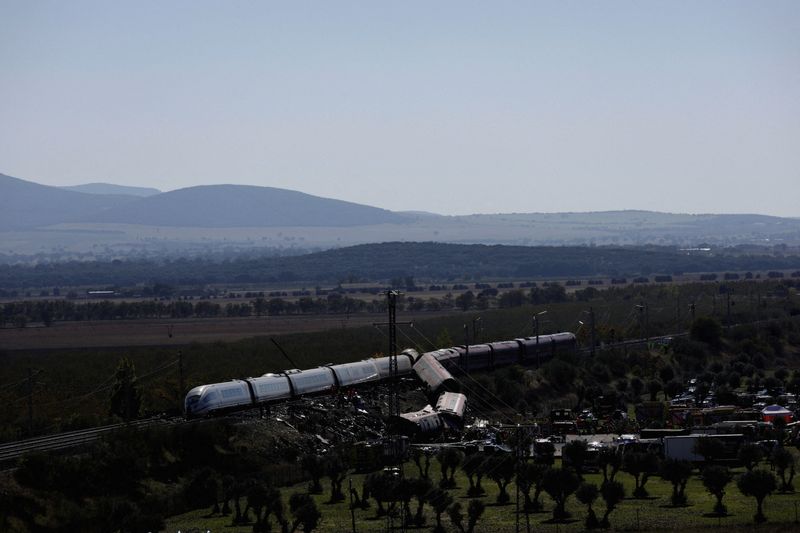
Spanish rescuers search for victims as train crash death toll rises to 69

By Guillermo Martinez and Michael Francis Gore
URDA, Spain, Oct 29 (Reuters) - Rescuers picked through mangled carriages on Thursday in a grim search for victims of Spain's second fatal high-speed train
crash this year, as the death toll rose to 69 and hopes of finding further survivors faded.
After cranes worked through the night to lift parts of the wreckage of Wednesday's crash, emergency workers were seen carrying what appeared to be a body wrapped in a blanket from one of the trains in the central Spanish province of Toledo.
Regional leader Emiliano Garcia-Page said the death toll had risen to 69 people and that human remains had been found during overnight rescue efforts. Work now involved crane operations, particularly on a carriage that was still overturned.
"We do not believe there could be any more fatalities beneath that one, but I say this with caution," he said.
TRAIN DRIVERS STRIKE
Meanwhile, train drivers in Spain went ahead with a previously planned strike to press for more investment in railway safety a day after Europe's deadliest train accident since a 2013 derailment in Spain's Santiago de Compostela.
The crash, which followed another fatal accident in January involving the same rail companies on the same line, has also upended campaigning for a November 29 snap election, with the leaders of Spain's two main parties suspending campaign events.
Spain's government has declared three days of national mourning for those killed when one high-speed train hit another.
Pope Leo sent his condolences to the families of those killed, wished a speedy recovery to the injured and conveyed his support and comfort to all affected, the Vatican said, adding he had also encouraged rescue workers to continue their efforts.
Of those injured, authorities said 57 remained in hospital.
The crash prompted a major operation, which Spain's interior ministry said involved the deployment of more than 800 military and police personnel, over 200 vehicles, three helicopters, a mobile command post, drones, mounted units and search dogs.
As investigations began, a judge in Toledo barred anyone not involved in emergency, security, healthcare or judicial work from the crash site with a 2-km (1.2-mile) exclusion zone in both directions along the Madrid-Seville high-speed rail line.
POLITICAL LEADERS TRAVEL TO CRASH AREA
Socialist Prime Minister Pedro Sanchez, who travelled to Toledo to take part in a meeting to monitor and coordinate the emergency response, said authorities were working "day and night" to support the victims and their families and to "get to the bottom of every last detail of this tragedy".
Meanwhile, Alberto Nuñez Feijoo, leader of the centre-right People's Party, which is currently leading in polls, was due to visit the town of Urda, where local people rushed to help with rescue efforts in the aftermath of the crash.
Spain's foreign ministry said 42 foreign citizens from seven countries were involved in the crash, information available so far showed, of whom one was killed and at least seven injured.
Wednesday's accident has added urgency to a debate about safety on Spain's railways, Europe's longest network and until recently a source of pride in the country.
Spanish Transport Minister Oscar Puente said on Wednesday the crash happened after several trains stopped automatically due to a signal failure. A state-run Renfe train was then authorised to proceed at normal speed, even though there was a stationary Iryo-operated train ahead.
SEMAF, the Spanish train drivers' union, said it did not want to speculate on the cause of the crash.
"We wish to exercise caution until we have a detailed understanding of exactly what happened, so as not to engage in speculation," SEMAF said in a statement late on Wednesday.
Train drivers would go ahead with the strike that had already been planned before the accident to press for structural changes in railway safety, SEMAF said, adding that it was studying further action.
Renfe said the strike had caused significant disruption to rail services and passengers could change or cancel tickets free of charge and would be notified of affected services.
(Reporting by Charlie Devereux, Corina Pons and Mireia Merino; Additional reporting by Gianlucca Semeraro; Writing by Alexander Smith; Editing by Alex Richardson)