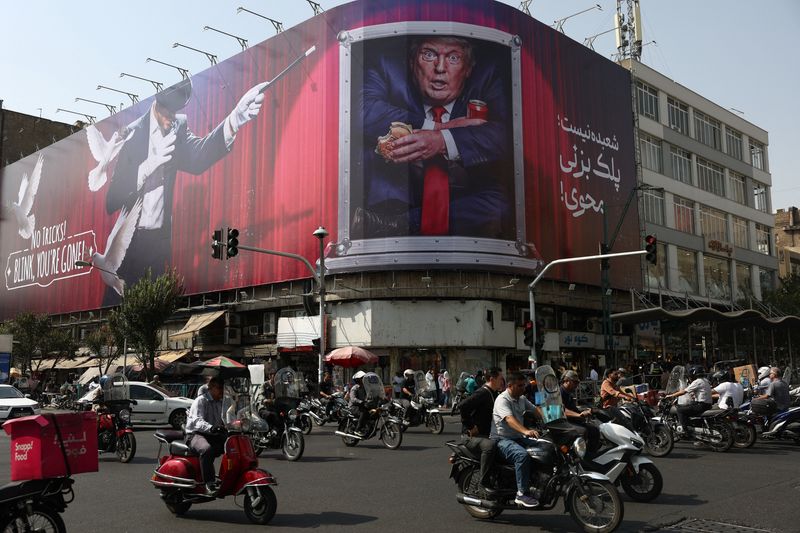
Iran defiant as Bessent says US likely to announce bank sanctions this week

By Parisa Hafezi and David Lawder
DUBAI/ASHEVILLE, North Carolina, Sept 1 (Reuters) - U.S. Treasury Secretary Scott Bessent said on Tuesday Washington was likely to announce bank sanctions against Iran
this week, stepping up an attempt to "economically asphyxiate" Iran's leadership after six months of conflict.
Oil prices rose further after the first exchange of direct attacks since July and reports of two tankers being hit leaving the Strait of Hormuz, the global oil supply waterway that Iran has effectively closed to shipping.
Tehran remained defiant, warning that it would prevent oil being exported from the Gulf, despite a threat by U.S. President Donald Trump to hit Iran "hard" in response to the renewed Iranian strikes, and Bessent's warning that Washington was about to impose new sanctions.
'ZERO TOLERANCE'
"We are probably going to announce a bank sanction this week, and we will announce one the week after. We are speaking to our allies here, who have all come forward, and we have had a great show of support," Bessent said at a G20 finance leaders' meeting in Asheville, North Carolina.
He said the U.S. was also looking at targeting airline leasing companies and other entities that did business with the Islamic Revolutionary Guard Corps (IRGC).
"We have zero tolerance. We are going to economically asphyxiate this regime," he said.
Iran's leaders have defied decades of U.S. sanctions, many of which have been aimed at curtailing Tehran's oil revenues and acquisition of weapons components.
"If the enemy wants us not to export oil from the Persian Gulf, no one will be able to export oil," Iranian parliament speaker Mohammad Baqer Qalibaf was quoted by Iranian media as saying.
Bessent has also warned that countries doing business with Iran could face U.S. sanctions.
The six-month-old conflict had shifted into an economic standoff before the weekend strikes, in which U.S. forces attacked Iran's Larak Island on Sunday and Iran responded by launching missiles at two U.S. air bases in Jordan.
Although he warned of a U.S. response to the Iranian strikes, Trump also told reporters on Monday that they did not signal a return to full-scale war, and a senior Iranian source told Reuters they were a "limited and contained confrontation".
But pledges by both sides to respond to further attacks have highlighted how quickly a conflict that has increasingly been fought through sanctions, blockades and economic pressure could spill back into military action.
IRAN'S DEFIANCE
Before Bessent's latest remarks, Iranian President Masoud Pezeshkian said Tehran would reciprocate immediately if Washington honoured its commitments under a June Memorandum of Understanding that was intended to halt the conflict.
The MOU declared an end to fighting that has now killed thousands in Iran and Lebanon since U.S. and Israeli strikes began on February 28. But it also deferred many of the most difficult issues and paved the way for a broader 60-day negotiation period - which passed without further agreement.
"I am stating clearly that if the U.S. returns to its commitments under the Memorandum of Understanding, the Islamic Republic of Iran will immediately reciprocate," Pezeshkian said in the Kyrgyz capital Bishkek at a summit of the Shanghai Cooperation Organisation, which includes Russia and China.
But Iranian officials show no public sign of bowing to pressure, with Qalibaf quoted by Iranian media as saying Tehran would respond militarily if the U.S. intensified its "siege".
Foreign Ministry spokesman Esmaeil Baghaei told a press conference in Tehran that Washington was "addicted to making excessive demands and has mistaken negotiations for dictating terms".
"As long as they act in this manner, they will certainly get no result other than what they have achieved so far," he added, warning that Tehran would "use all our capabilities, whether on the battlefield or through our diplomatic apparatus".
FEARS THAT IRAN CONFLICT COULD 'RUN AND RUN'
The heightened tensions have renewed fears of oil supply disruptions from the world's key crude-producing region, with Brent futures rising more than 2% on Tuesday.
"The tit-for-tat missile exchanges between the U.S. and Iran bring validation to those who believe that even if not a ‘forever war’, this conflict will run and run," said PVM analyst John Evans.
Highlighting such concerns, two supertankers carrying Saudi oil were struck by unknown projectiles within minutes of each other while transiting outbound through the Strait of Hormuz late on Monday, according to data from shipping intelligence and tracking firms Marisks and Kpler.
Despite the U.S. economic war, Iran's central bank governor, Abdolnaser Hemmati, said on Tuesday that Tehran had sufficient foreign currency reserves.
The central bank was ready to inject up to $2 billion into the foreign exchange market to calm recent volatility, Hemmati was quoted as saying by the semi-official Tasnim news agency.
"I am telling the president of the United States: Iran has (foreign) currency and it has enough," he said.
His comments appeared partly aimed at reassuring markets after Iranian officials, including Pezeshkian, pointed to growing difficulties for Iran's economy.
Iran’s currency plunged to a record low in August, crossing the psychological threshold of 2 million rials to the dollar, while annual inflation reached 66% in July.
(Additional reporting by Dubai newsroom; Writing by Timothy Heritage; Editing by Kevin Liffey)