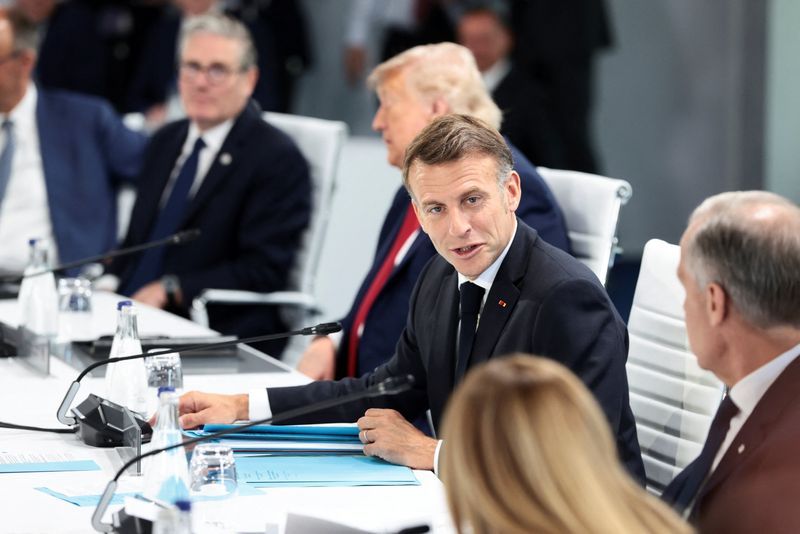
Macron, Carney pledge closer ties in Atlantic island meeting amid strains with Trump

By John Irish
Sept 20 (Reuters) - The leaders of France and Canada on Sunday pledged closer ties to grapple with rising geopolitical tensions, climate change and the erosion of democratic values, after
they met in the French territory of Saint-Pierre and Miquelon off Canada's Atlantic coast.
The two leaders' visit to the territory, the first by a French president since 2014 and the first by a Canadian prime minister, followed just weeks after US President Donald Trump posted an image showing the islands, as well as all of Canada and other countries in North America, covered by the US flag.
Ottawa has been seeking closer ties with the European Union amid an increasingly acrimonious trade war with the United States.
"Our societies are being shaken by new storms: the upheavals, caused by climate change, the erosion of democratic norms, and new threats to our sovereignty," Carney said in a statement alongside Macron. "The time has come to strengthen our ties."
Macron added that the two allies agreed to forge closer ties in sectors ranging from space and climate to energy.
"We both believe in democracy, the rule of law, respect for international law, respect for free and fair trade, science as the basis for our decisions, and the strategic autonomy that we defend," he said.
VISIT CARRIES SYMBOLIC WEIGHT
Diplomats said the visit by Macron, who was en route to the annual United Nations General Assembly of world leaders, had a symbolic weight following Trump's social media post.
The image Trump shared showed the US flag draped over a map of the United States, Canada, Greenland, Iceland, Mexico, Central America and the Caribbean, and was labelled "United States of America". It included Saint-Pierre and Miquelon and French Caribbean territories.
Responding to questions on Trump's post, Macron dismissed any notion that the territories could not be French and said he did not need to reaffirm that point every day just because "people have strange ideas or say strange things."
For France, Saint-Pierre and Miquelon is strategically important due to its location on the doorstep of the US and the Arctic.
The territory also occupies a key place in France's cooperation with Canada, including over energy.
Macron, whose government is facing increased pressure at home over rising fuel prices, said the talks had opened the door for bilateral discussions aimed at sealing concrete deals. Paris hopes Canada will broaden its exports of liquefied natural gas to Europe rather than primarily to Asia.
"Canadian liquefied natural gas projects can help. They are important for Europe," Macron said.
The two leaders also discussed Canada's relationship with the EU after the bloc opened the door to Ottawa becoming its first associate member, something Macron said France supported.
Any move towards deeper integration, however, is likely to face hurdles. More than a decade after the EU and Canada agreed to the Comprehensive Economic and Trade Agreement, and nine years after its provisional application began, several EU member states have yet to ratify the accord, including France.
(Reporting by John Irish at the United Nations; Editing by Chizu Nomiyama, Helen Popper and Edmund Klamann)